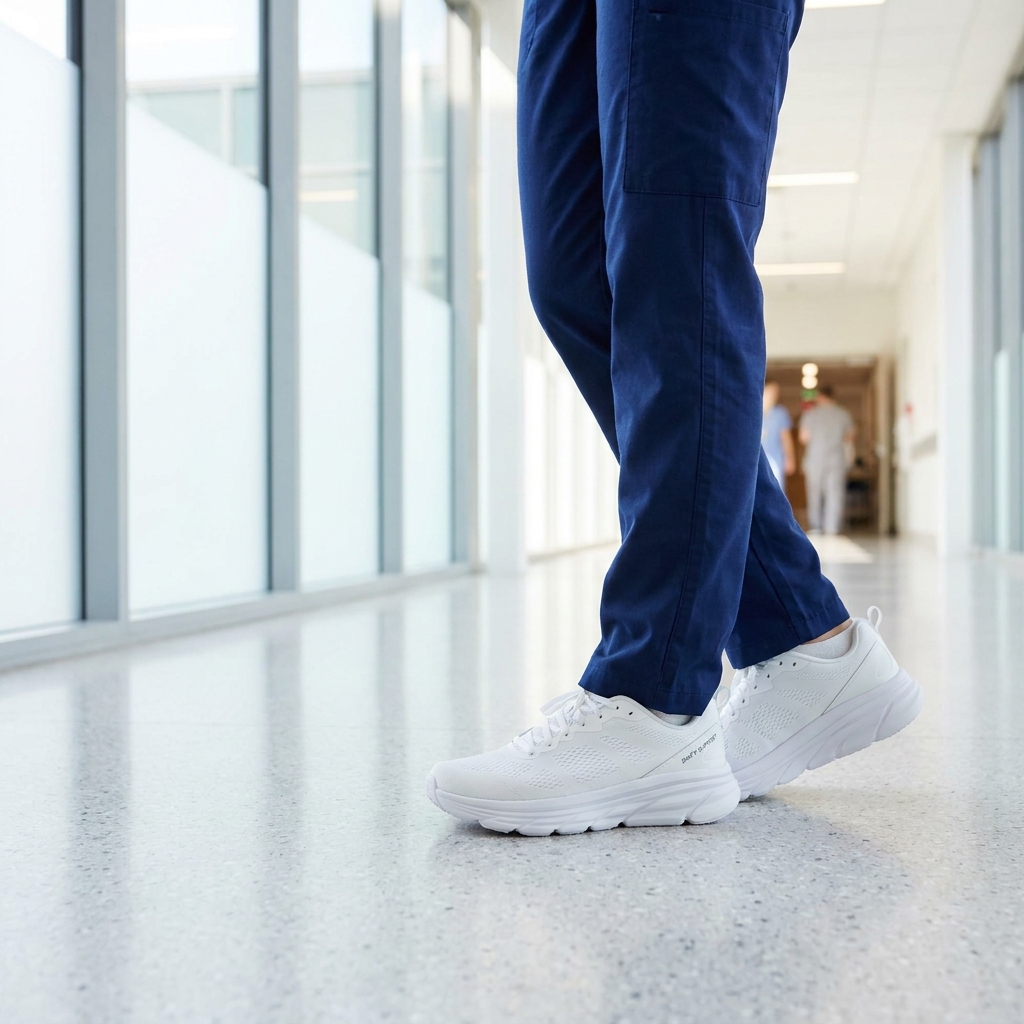
Best Shoe for Medical Professionals: A 2026 Condition-Based Guide
Introduction: Why Generic “Best Shoe” Lists Fail Medical Professionals
Stolt and colleagues report that nurses walk an estimated 4 to 5 miles during a single 12-hour shift. At that distance, footwear stops being a style choice and becomes a clinical decision. In ICU wards, clinicians spend an average of 68.3% of their shift on their feet; in medical/surgical wards, that figure rises to 70.4%.
Most online guides still rely on a familiar formula: “Best Overall,” “Best Budget,” “Best Clog.” That format overlooks a basic fact: foot pain has different root causes, and each one calls for a different biomechanical solution. A shoe that relieves plantar fasciitis may aggravate a bunion. A shoe that cushions a long shift may give an overpronator too little stability.
TopDoctor Magazine takes a different approach. This guide organizes recommendations by condition and stressor: plantar fasciitis, bunions, overpronation, long shifts, wide feet, and slip hazards. Each pick includes podiatrist-style clinical reasoning instead of crowd-sourced testimonials. The evaluation criteria are APMA Seal of Acceptance status, stack height, heel-counter rigidity, and arch support type. The guide covers all medical professionals, including nurses, CNAs, physical therapists, technicians, physicians, and physician assistants.
The Hidden Epidemic: Why Medical Professionals’ Feet Are at Risk
Foot problems in healthcare are common and well documented. In one US observational study of 304 nurses, 54% reported bunions, curled toes, flat feet, high arches, calluses or corns, heel spurs, or pain. A scoping review indexed by the National Library of Medicine found foot pain prevalence ranging from 21.2% in Portugal and 23% in Japan to 42% in Poland and 55.3% in Australia. The problem is universal, not local.
More than 50% of nurses report foot or ankle musculoskeletal disorders (MSDs) over a 12-month period. These conditions rank among the top three MSDs, behind lower-back and neck problems. The research also shows a clear link to standing:
- Prolonged standing carries a 1.7-fold risk for foot pain.
- In surgical units, the odds of ankle-foot pain were 5.7 times higher among nurses with prolonged standing, according to research published in the Journal of Pain Research.
- In one survey, 34.2% of nurses stood for eight hours daily, and standing hours were significantly associated with worse foot health scores (p=0.04).
Foot pain also affects careers and staffing. Twenty-four percent of nurses missed work in the past 12 months because of foot and ankle pain, making it the second-leading cause of absenteeism among healthcare professionals.
The first step toward relief is identifying the specific condition or stressor involved, rather than buying whatever is currently popular.
How We Evaluated These Shoes: Our Clinical Criteria
APMA Seal of Acceptance. The American Podiatric Medical Association awards its Seal to products found to have significant value when used in a consistent program of daily foot care and regular professional care. Podiatrists review each product for support, structure, cushioning, and overall design. APMA-accepted brands relevant to this guide include HOKA, Brooks, New Balance, ASICS, Dansko, Vionic, Altra, Skechers, Orthofeet, and Clove. Seal status applies to specific models, so buyers should confirm the exact model in the APMA’s official database.
Heel-to-toe drop. Drop is the height difference between the heel and the forefoot. A higher drop shifts pressure forward and reduces plantar fascia strain. Podiatric guidance recommends 10 to 12mm for people with active plantar fasciitis.
Rocker-sole mechanics. The Dansko Professional is a useful example. In-shoe pressure analysis indicates its rocker bottom reduces propulsive load at the plantar fascia origin by approximately 30%.
Podiatrist feature checklist:
- Heel stability
- A slightly elevated heel (1 to 1.5 inches)
- A firm midsole
- A thick outsole
- An optional rocker bottom to avoid overstretching the plantar fascia
Running shoes vs. nursing shoes. Podiatric guidance suggests that quality running or walking shoes often outperform shoes marketed as “nursing-specific.” Running shoes are built for sustained impact, all-day cushioning, and arch support.
Regulatory context. OSHA regulation 29 CFR 1910.136 requires employers to assess foot hazards and ensure workers wear protective footwear that meets required standards. For slip resistance, the ASTM F2913 rating is the technical benchmark to look for.
This guide cross-references APMA Seal data, peer-reviewed prevalence studies, and podiatric criteria. It does not rely only on crowd-sourced reviews.
Best Shoes by Condition and Biomechanical Stressor
This section is the core of the guide. Readers should find the condition or stressor that matches their situation instead of scrolling through an undifferentiated top-10 list.
If You Have Plantar Fasciitis
Clinical rationale: Repeated heel strikes strain the plantar fascia throughout a shift. Relief depends on a 10 to 12mm drop, a firm midsole, and dependable arch support.
- Primary: HOKA Bondi 9 / Bondi SR. This shoe has a high stack height and maximal cushioning for shock absorption, and the Bondi 9 holds APMA acceptance.
- Secondary: Dansko Professional / XP 2.0. Its rocker-bottom sole reduces propulsive load at the plantar fascia origin by about 30%.
- Under-covered pick: Orthofeet. The brand’s plantar fasciitis styles include built-in orthotic footbeds and extended width options designed for heel pain.
Clinical-audience guidance aimed at nurses also recommends HOKA, Brooks, ASICS, Dansko, Vionic, and New Balance for managing plantar fasciitis. Practical tip: if a shoe lacks built-in arch support, pair it with an APMA-accepted orthotic insert.
If You Have Bunions
Clinical rationale: Bunions need wide, flexible toe boxes and soft uppers that avoid pressure over the first metatarsophalangeal joint.
- Primary: Vionic bunion-friendly models. These offer roomier toe boxes and built-in orthotic arch support that relieves forefoot pressure.
- Secondary: New Balance 860v15 or similar wide-last options. Stretchable mesh uppers accommodate bunion width without compressing the joint.
- Under-covered pick: Orthofeet bunion styles. Seam-free, stretchable interiors are designed to eliminate rubbing at the bunion joint.
People with bunions should avoid rigid, narrow-toed clogs and dress-style shoes. Over a 12-hour shift, these can make pain significantly worse.
If You Overpronate
Clinical rationale: Overpronation is an excessive inward roll of the foot. Controlling it requires structured medial support and a firm heel counter.
- Primary: Saucony Guide 19. Its stability-engineered midsole is designed for pronation control.
- Secondary: Brooks Adrenaline GTS 25 (APMA-accepted) or Brooks Ghost Max 3. These combine cushioning with a guided support structure. The Adrenaline is the stronger choice for overpronators who need true stability.
Heel-counter rigidity matters. A firm, well-molded heel counter keeps the ankle from rolling on hard hospital floors. Overpronators should avoid minimalist or neutral-cushion shoes, even ones that appear on popular nursing-shoe lists.
If You Work 12-Hour Standing Shifts
Clinical rationale: Clinicians spend 68.3% to 70.4% of shift time on their feet, depending on the unit. Long shifts call for maximal cushioning and fatigue resistance to offset this sustained load.
- Primary: HOKA Bondi SR. It pairs a slip-resistant outsole with a maximalist stack height built for all-day wear.
- Secondary: Brooks Ghost Max 3. Its high-stack cushioning is designed for sustained impact absorption.
- Under-covered pick: STAND+ (Gales). These shoes are purpose-built for standing-intensive professions and designed to reduce fatigue.
Shift timing also matters. Among nursing assistants, day shifts involved walking for 48.4% of the time, compared with 23.1% on night shifts (1,704 versus 763 steps per hour). Day-shift clinicians may want to place an even higher priority on cushioning.
If You Have Wide Feet
Clinical rationale: Standard D-width shoes compress wide feet. Over long shifts, that compression contributes to calluses, bunions, and nerve irritation.
- Primary: New Balance 1080v15 / 990v6. Both are widely available in 2E and 4E widths with roomy toe boxes.
- Secondary: Orthofeet wide-fit line. Extra depth and stretchable uppers accommodate wide and swollen feet.
- Under-covered pick: Uni Shoes. This newer brand offers accommodating width profiles and appears increasingly in 2026 nurse-specific roundups.
Practical guidance: get a professional width fitting instead of sizing up in a standard width. Sizing up changes how the heel fits and increases the risk of blisters.
If You Face Slip Hazards (OR, ICU, Wet Floors)
Regulatory rationale: Under OSHA 29 CFR 1910.136, employers must assess foot hazards. When conditions require it, employers must ensure workers wear slip-resistant footwear. Buyers should look for an ASTM F2913 slip-resistance rating on product specifications.
- Primary: Calzuro. This autoclavable, waterproof clog is built for OR and sterile environments and has a slip-resistant outsole.
- Secondary: Dansko Professional. It has long been trusted in surgical settings for its slip-resistant rocker outsole and easy-to-clean upper.
- Under-covered pick: HOKA Bondi SR. It combines maximalist cushioning with a slip-resistant outsole for floors with mixed hazards. Buyers should confirm the current rating on the manufacturer’s spec sheet.
When a hazard assessment identifies the need for slip-resistant soles that ordinary footwear lacks, employers must provide that footwear. This requirement can support reimbursement conversations with HR or management.
Comparison at a Glance: Condition-Based Shortlist
| Condition / Stressor | Recommended Shoe(s) | Key Clinical Feature | Price Tier |
|---|---|---|---|
| Plantar fasciitis | HOKA Bondi 9/SR; Dansko Professional; Orthofeet | High drop, APMA-accepted, rocker sole (~30% load reduction) | $$–$$$ |
| Bunions | Vionic; New Balance 860v15; Orthofeet | Wide, flexible toe box; seam-free uppers | $$–$$$ |
| Overpronation | Saucony Guide 19; Brooks Adrenaline GTS 25 | Medial support, firm heel counter, APMA-accepted (Adrenaline) | $$ |
| 12-hour shifts | HOKA Bondi SR; Brooks Ghost Max 3; STAND+ | Maximal stack height, fatigue resistance | $$–$$$ |
| Wide feet | New Balance 1080v15/990v6; Orthofeet; Uni Shoes | 2E/4E widths, extra depth | $$–$$$ |
| Slip hazards | Calzuro; Dansko Professional; HOKA Bondi SR | Slip-resistant outsole (check ASTM F2913), autoclavable (Calzuro) | $$–$$$ |
Price tiers: $$ = roughly $100–$150; $$$ = $150 and above. Prices vary by retailer.
Frequently Asked Questions
Why do feet hurt so much after a shift?
Clinicians walk 4 to 5 miles per 12-hour shift and spend most of their time standing. Prolonged standing raises the risk of foot pain 1.7-fold overall. In surgical units, the odds of ankle-foot pain are up to 5.7 times higher.
Are HOKA shoes actually good for nurses?
For many people, yes. Models like the Bondi 9 have high stack heights and APMA acceptance. Maximal cushioning helps most during long, high-mileage shifts. Overpronators may need more structured stability than a neutral HOKA provides.
Are running shoes better than “nursing shoes”?
Often, yes. Podiatric guidance favors quality running shoes because they are designed for sustained impact and arch support.
What is the APMA Seal of Acceptance, and why does it matter?
The Seal recognizes products that podiatrists have found to have significant value in a consistent foot-care program. It is the most reliable third-party trust signal available to footwear buyers.
Does an employer have to provide slip-resistant shoes?
Employers must provide slip-resistant footwear when a hazard assessment shows that work conditions require special slip-resistant soles not found on ordinary footwear.
How often should medical professionals replace their shoes?
Cushioning breaks down with mileage. At 4 to 5 miles per shift, a full-time clinician can accumulate hundreds of miles within a few months. Many podiatrists suggest replacing work shoes every 6 to 12 months, or sooner if the midsole feels flat or wear becomes uneven.
Can foot pain lead to other musculoskeletal issues?
Foot pain often occurs alongside other problems. One study found that 55% of nurses experience low back pain and 42% experience neck pain. Proper footwear is one part of a broader approach to ergonomics.
Conclusion: Matching the Shoe to the Condition, Not the Trend
No single shoe is the best choice for every medical professional. The right shoe depends on the condition, and clinical reasoning should drive the purchase. Criteria such as APMA Seal status, stack height, heel-counter rigidity, and arch support type are more reliable guides than popularity rankings. Foot pain is a documented occupational hazard, with more than 50% annual prevalence and a 24% absenteeism rate, so it is worth addressing before it becomes serious. Readers should identify their specific condition from the sections above before buying, and see a podiatrist if pain persists or worsens.
Take the Next Step Toward Healthier Shifts
TopDoctor Magazine publishes evidence-based health and wellness journalism on occupational health topics that matter to clinicians. Readers can subscribe to the free biweekly TopDoctor Magazine newsletter for ongoing clinician-focused wellness content. Anyone with persistent foot pain should consult a podiatrist or primary care provider. Readers who know an outstanding foot-health specialist can nominate that professional through TopDoctor Magazine’s doctor nomination platform. Choosing footwear based on evidence is a practical part of preventing injury and protecting long-term health, and it helps clinicians stay on their feet for their patients.