Aging Research and Drug Discovery (ARDD), now in its 13th year, is the premier scientific meeting on the molecular biology of aging. It has been held in Copenhagen for over a decade. In March, the conference organizers received bad news. The University of Copenhagen canceled it.
The field’s flagship scientific gathering needed a new home on short notice. It landed in Boston and will open October 1st at Harvard’s Rubenstein Treehouse.
That is the kind of thing that reveals where a center of gravity actually sits. When a conference has to relocate quickly, and the field agrees on the destination without much argument, the destination has already won something.
What Is Actually Happening in Boston, October 2026
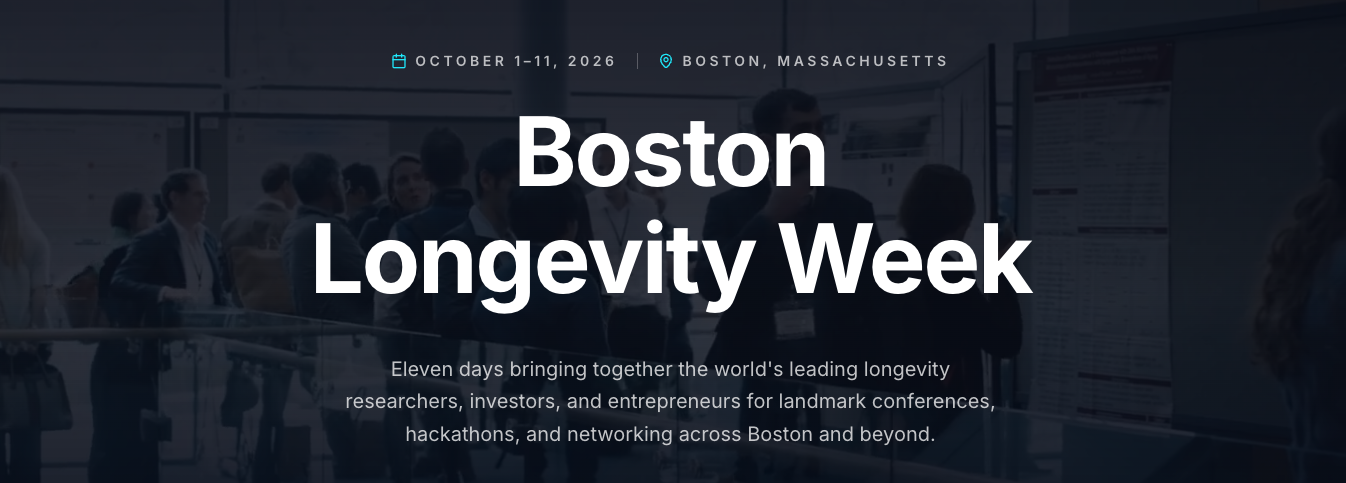
ARDD is just one piece of Boston Longevity Week, a 10-day event running from October 2nd through 11th and featuring a lineup that keeps growing with a range that tells you something about the ecosystem’s shape.
On the hard science side, you’ll find ARDD itself and a half-day symposium on the biology of brain aging covering cognitive decline, neuroimaging, and the biomarkers used to track it. On the capital side, an invite-only pitch night where six longevity startups present to investors from more than 30 venture firms focused on the sector. For founders and operators, Boston Health Innovation Night at the Liberty Hotel adds a layer of networking. The agenda also includes standard work aimed at building clinically validated ways to measure aging and assess whether an intervention made a difference, plus a TEDx event and additional programming at the Berkshire Innovation Center in Pittsfield.
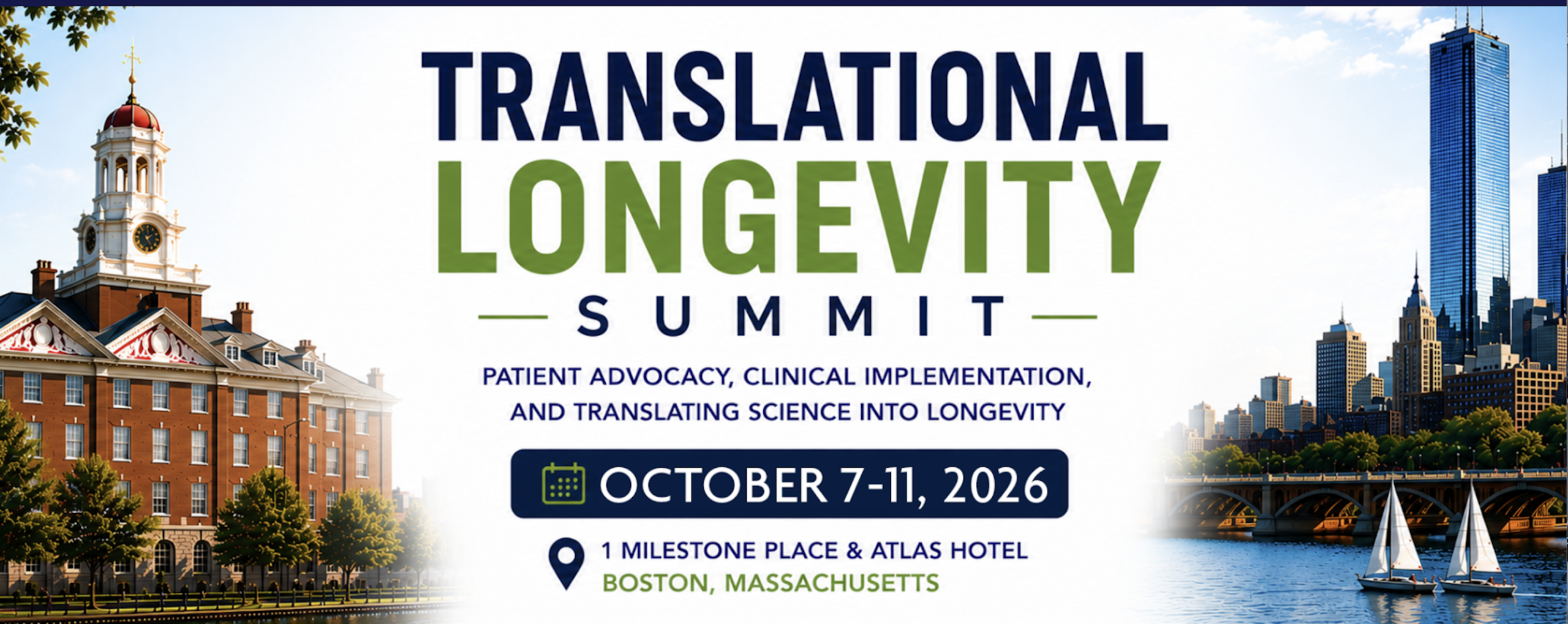
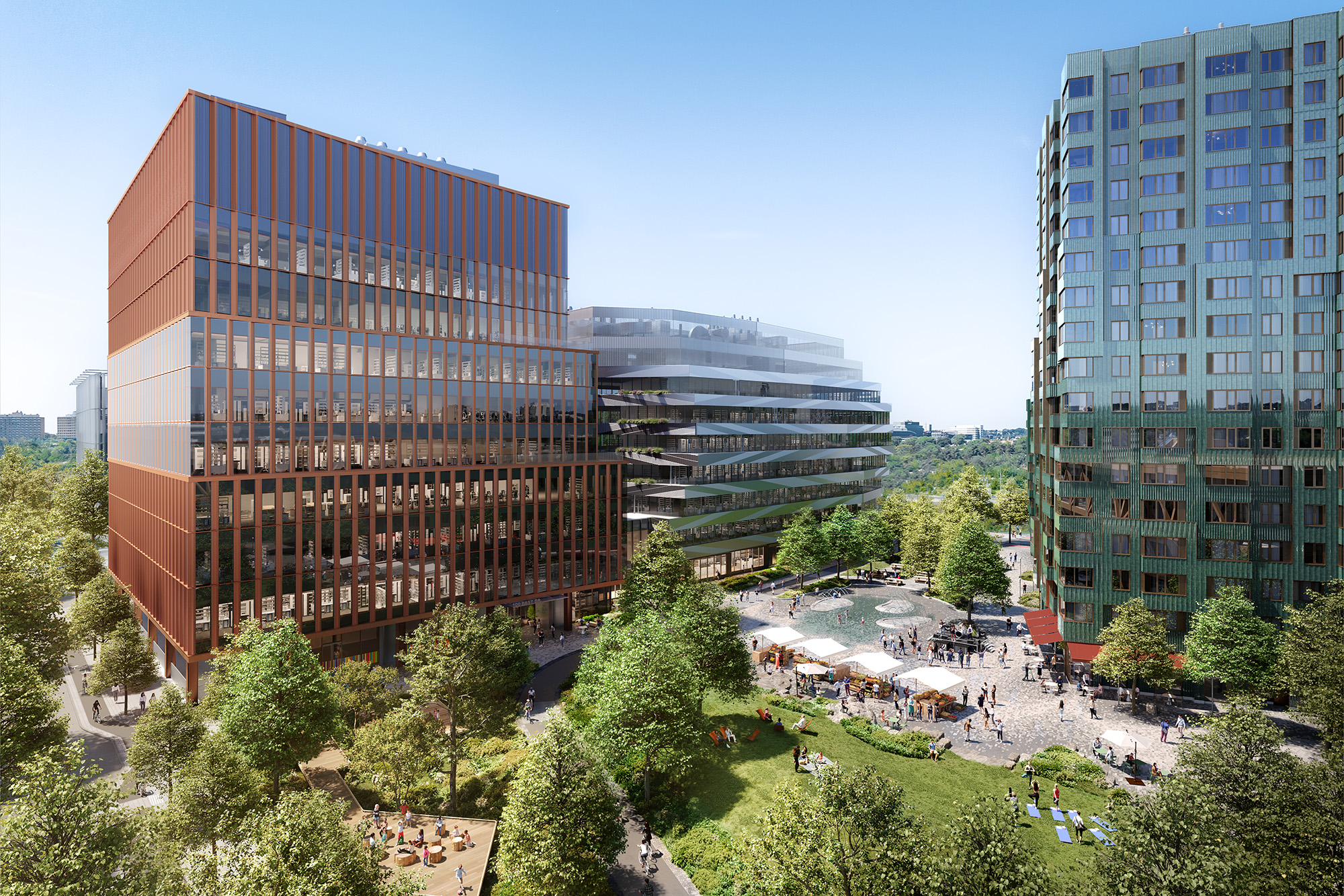
The week closes with the Translational Longevity Summit, a five-day gathering at Harvard’s Enterprise Research Campus convened by Boston BioLife and the Healthspan Action Coalition. Its central question is one the rest of the week keeps circling: How does any of this reach a patient?
No single organization built this. It assembled itself, which is potentially the more interesting fact.
The Case for Boston
Start with money. According to recent sector analysis, North America captured roughly 96.7 percent of disclosed longevity capital over the past 12 months, with an average round size of $62.3 million. The dollars are already in this hemisphere.
Then look at where the largest single funder chose to base its North American operation. Hevolution Foundation, the Saudi-backed organization committing up to $1 billion annually to aging research, established its North American headquarters in Boston at 200 Clarendon Street. It picked the city specifically for the density of life sciences there. Hevolution is also the single largest backer of the XPRIZE Healthspan competition, funding $40 million of the $101 million purse.
Add the institutions. Harvard, MIT, Mass General, Brigham and Women’s, Boston University’s Center for Regenerative Medicine, and the Kendall Square biotech cluster sit within a few miles of one another. Boston Magazine has already run the “America’s longevity capital” framing more than once.
That combination is unusual. Plenty of places have researchers. Plenty have capital. Fewer have researchers, capital, teaching hospitals, and regulatory-grade clinical infrastructure inside the same transit system.
The Case Against
Here is where the honest version diverges from the boosterish one.
Boston is not the world’s longevity capital by every measure, and pretending otherwise would be easy to disprove.
Europe holds roughly 28 percent of the longevity market, and Switzerland dominates the premium clinical end. Clinique La Prairie runs programs starting around $53,000 per week and is expanding into China, Thailand, Taiwan, and Saudi Arabia. Singapore has built a genuine position in precision medicine, advanced diagnostics, and preventive care, backed by a medical tourism infrastructure that Boston does not have and is not trying to build.
The Gulf is moving fastest of all. Dubai has established a dedicated Longevity Authority. Saudi Arabia has folded longevity into Vision 2030 alongside NEOM. Analysts covering the region expect the GCC to stand alongside Switzerland, Singapore, and California among the top longevity innovation hubs by 2030. Additionally, the money flowing into Boston’s ecosystem from Hevolution is, notably, Saudi money.
The United Kingdom has committed more than £2 billion in public funding through its Life Sciences Sector Plan, including £600 million for a national health data platform.
So the claim needs qualifying. Boston is not winning longevity tourism. It is not winning the luxury clinic market. It is not winning sovereign-scale policy commitment.
The Prize Boston Is Actually Competing For
Boston’s claim is narrower and, for founders, more valuable: it is becoming the place where longevity science gets validated.
That distinction matters more than it sounds. The longevity industry’s bottleneck is not capital. Investment more than doubled in 2024 to $8.49 billion, with Alphabet, Bezos, and Altman all funding major plays. There are more than 3,200 longevity startups globally, and no company holds more than 5 percent of the market. Money is not scarce. Credibility is.
The sector’s real constraint is that most of what it sells cannot yet be defended with evidence a physician would act on. Consumer demand has outrun clinical validation by a wide margin, and that gap is the industry’s central business risk. Every founder in this space eventually meets a clinician, a regulator, or an insurer who asks for the data.
Boston is where that question gets answered. The institutions that can run the trials, the clinicians who will adopt or reject a protocol, the standards work on aging biomarkers, and the capital that funds the next round are all in one place. That is a translation layer, not a marketplace.
For anyone building in this sector, that suggests a strategic reordering. Proximity to capital used to be the reason to pick a city. In a field where funding is abundant, and evidence is scarce, proximity to validation is worth more.
What This Means if You Are Building Something
Three things follow:
Pick your city for what you lack, not what you have. If your constraint is evidence, Boston. If it’s market access to affluent consumers, Dubai or Singapore. If it’s regulatory permissiveness, neither.
Budget for validation the way you budget for engineering. The companies that will survive the sector’s coming consolidation are the ones that can show their work. That is a line item, not a marketing exercise.
Show up in October: 10 days, 30-plus venture firms in one room, and the field’s flagship scientific meeting. Ecosystems are built by the people who keep showing up.
Boston may not be the longevity capital of the world, but it is becoming the place where the world’s longevity claims get tested. In an industry with a credibility problem, that is the better title to hold.