Professional Samples for Healthcare Providers: 2026 Compliance Rules
Introduction: Samples Arrived. Now What?
A pharmaceutical representative drops off a box of samples at the front desk, or a shipment arrives by common carrier. For many clinicians, the first reaction is enthusiasm: a new therapy to try, or a way to help a patient who cannot yet afford a prescription. That moment, however, is also when a compliance responsibility begins.
Most online content about free samples for healthcare providers explains where to find them. This article covers what happens once samples enter a practice.
Physicians, nurse practitioners, physician assistants, and practice managers have to work across several overlapping frameworks:
- Federal law under the Prescription Drug Marketing Act (PDMA)
- Drug Enforcement Administration (DEA) rules for controlled substances
- Sunshine Act reporting requirements for samples
- Industry codes such as the PhRMA Code
- American Medical Association (AMA) ethics opinions
- State mandates, such as California’s locked-storage requirement
This guide brings those frameworks together into one compliance explainer for 2026. The stakes are real: mishandled samples can expose a practice to FDA enforcement, DEA audits, state medical board discipline, and lasting damage to its reputation.
What Counts as a “Professional Sample” Under Federal Law
Under the PDMA, codified at 21 CFR Part 203, a drug sample is a unit of a prescription drug that is not intended to be sold. Its purpose is to promote the drug’s sale or to distribute it to patients.
Congress enacted the PDMA in 1987 for two reasons:
- Supply chain protection: keeping counterfeit, adulterated, and diverted pharmaceuticals out of the drug supply.
- Curbing resale abuses: samples were being resold into commercial channels, and the law aimed to stop that.
Samples form their own regulatory category. They are not the same as:
- Purchased inventory
- Over-the-counter free samples
- Manufacturer coupons or vouchers
Both brand-name prescription drugs and controlled substances can be distributed as samples. When a sample is a scheduled drug, DEA obligations apply in addition to the PDMA rules.
Who Is Legally Allowed to Receive and Handle Samples
Under the PDMA, only three parties may provide a sample to a patient:
- A licensed prescriber
- A healthcare professional acting under that prescriber’s supervision
- A hospital or entity pharmacy acting at the prescriber’s direction
Manufacturers cannot ship samples directly to patients outside these channels. The one notable exception came during the COVID-19 Public Health Emergency, when the FDA temporarily relaxed the requirement that samples go to prescribers first, allowing manufacturers to ship samples to patients under telehealth oversight.
Since the emergency ended, policymakers and industry have continued to debate whether a permanent direct-to-patient pathway should exist. Practices should not assume that the pandemic-era flexibility still applies in 2026. Unless the FDA formally establishes a new pathway, the traditional prescriber-centered model governs.
Delegation is the other key question. Nurse practitioners and physician assistants with prescriptive authority may often request and distribute samples in their own right, depending on state scope-of-practice law. Nurses and medical assistants generally may hand samples to patients only under a supervising prescriber’s direction. Practices should put these roles in writing so that every staff member knows where their authority ends.
The Request and Receipt Paperwork Trail
Mailed or shipped samples. For samples sent by mail or common carrier, the request must be in writing and include:
- The practitioner’s name and address
- Professional title
- Signature
- State license number, or DEA number for scheduled drugs
When the samples arrive, the practice must provide a signed receipt acknowledging delivery.
Hand-delivered samples. Regulatory updates in 1999 and 2000 extended receipt requirements to samples delivered in person, requiring representatives to leave a receipt for hand-delivered samples as well. The same rules required manufacturers and authorized distributors to build and maintain sample distribution security and audit systems. The FDA inspects those systems under Compliance Program 7356.022.
The manufacturer’s records do not protect the practice, however; a practice needs its own matching paper trail.
Practical tip: Designate a single staff member to log every rep-delivered sample at the moment of drop-off. Informal handoffs at a busy front desk are where most documentation gaps begin.
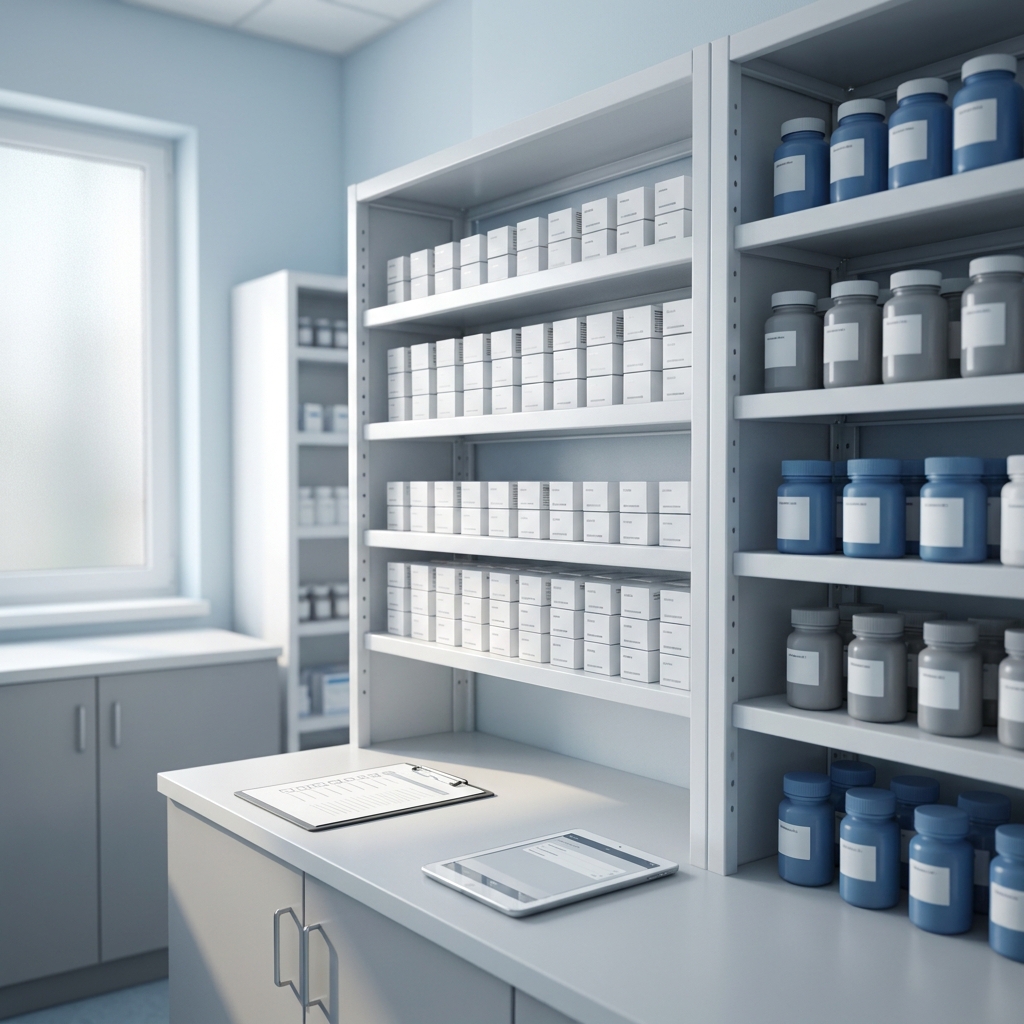
Storage and Security Requirements Every Practice Needs
Sound sample storage follows three principles:
- Security: keep samples in a dedicated, secured location.
- Segregation: store samples separately from purchased stock.
- Limited access: allow only authorized personnel to reach them.
Storage failures are among the most common findings in state medical board and health department audits. Typical problems include:
- Unlocked closets
- Expired product mixed in with current stock
- Samples stored in break rooms
These problems are easy for inspectors to observe and easy to document. They are also easy to prevent.
DEA Rules for Controlled-Substance Samples
Controlled-substance samples carry stricter obligations:
- Locked storage: Under 21 CFR 1301.75(b), they must be kept in a securely locked, substantially constructed cabinet.
- Complete records: 21 CFR 1304.04 requires full records covering the receipt, storage, and dispensing of every controlled-substance sample. The DEA Practitioner’s Manual reinforces this requirement.
- Theft and loss reporting: Theft or significant loss must be reported to the DEA Field Division office in writing within one business day of discovery. A formal DEA Form 106 follows.
Whether a loss is “significant” depends on several factors:
- The quantity involved
- The specific substance and its potential for diversion
- Whether losses follow a pattern over time
- Local diversion trends
The DEA also recommends periodic internal inventory reconciliation. Regular counts let a practice catch discrepancies before a DEA audit does.
State-Level Storage Mandates Layered on Top of Federal Law
California. California’s Business & Professions Code 4051.3 and Medical Board guidance require all drugs, including samples, to be stored in a locked space with access limited to authorized staff. In a multi-provider practice, this means:
- Keyed or badge-controlled access
- A current list of who may enter the storage area
- No shared keys left in open drawers
Other jurisdictions. New Jersey, Vermont, Minnesota, Massachusetts, and Washington, D.C. add their own gift- and sample-related restrictions or disclosure rules on top of the federal baseline.
New Jersey. New Jersey’s regulations broadly restrict and cap manufacturer gifts and payments to prescribers. Samples intended for patients are typically exempt from those limits, but they should still be documented. California’s SB 790 follows a similar model: it restricts gifts while carving out samples.
State requirements change faster than federal law. Practices should review their state medical board and pharmacy board rules at least once a year.
Recordkeeping and Audit-Readiness Checklist
State boards, the DEA, and the FDA typically ask for four kinds of records:
- Sample logs
- Signed receipts
- Inventory counts
- Dispensing records
Retention. The three-year retention standard required for donation records under 21 CFR 203.39 is a sensible benchmark for all sample documentation. DEA controlled-substance records carry their own minimum of two years, and some states require longer.
Internal audits. A quarterly or twice-yearly review should reconcile three numbers: samples received, samples dispensed, and samples discarded.
Common compliance gaps:
- Untracked rep drop-offs
- Missing signatures on receipts
- Controlled and non-controlled samples stored together
Dispensing, Donating, and Disposing of Samples Correctly
Dispensing Samples to Patients
Only authorized personnel acting under a licensed prescriber may hand samples directly to patients. At the time of dispensing, staff should record the lot number and expiration date in the patient’s chart. That record makes the sample traceable and allows the practice to respond quickly to a recall, a need that has grown alongside traceability expectations under the Drug Supply Chain Security Act.
Donating Leftover Samples to Free Clinics
21 CFR 203.39 permits practices to donate leftover samples to free clinics and charitable institutions, subject to two conditions:
- A licensed practitioner or pharmacist must visually inspect the samples before transfer.
- Distribution records must be kept for at least three years.
The FDA’s 2006 guidance on donating samples to free clinics eased some of the administrative burden on clinics that accept donations.
Practices should keep a simple donation log that records:
- The inspecting practitioner
- The date
- The recipient clinic
- The quantities donated
Disposing of Expired or Damaged Samples
Expired or damaged samples should never go into regular trash or down the drain.
- Non-controlled samples: use a reverse distributor or a licensed pharmaceutical waste vendor.
- Controlled-substance samples: use DEA-compliant destruction, typically through a DEA-registered reverse distributor. Keep documentation of the transfer, and complete DEA Form 41 where applicable.
Why Samples Don’t Show Up on Open Payments: The Sunshine Act Exclusion Explained
The Sunshine Act explicitly excludes product samples from Open Payments reporting. Buffet meals at large events and patient education materials are excluded as well.
As a result, physicians will not see samples listed as a “payment” in the CMS Open Payments database. This sometimes confuses providers who assume every manufacturer interaction is reportable.
The scale of the exclusion is significant. CMS data show that drug and device companies paid at least $13.2 billion to medical professionals in 2024, and samples sit entirely outside that figure. The AAFP has cited an estimate that the industry spends $13.5 billion a year on drug samples alone.
The exemption is narrow, however. Speaker fees, consulting arrangements, and similar activities remain fully reportable. Practices should keep sample handling and financial relationships separate in their compliance thinking.
Ethical Guardrails: PhRMA Code and AMA Opinion 8.061
The PhRMA Code’s Position on Samples
The PhRMA Code on Interactions with Healthcare Professionals, most recently updated in November 2024, states that providing product samples for patient use in accordance with the PDMA is acceptable. That position separates samples from prohibited gifts that benefit the clinician personally, such as tickets, artwork, or entertainment. The distinction rests on who benefits: samples are acceptable because they are meant for patients.
AMA Guidance on Personal and Family Use
AMA Code of Medical Ethics Opinion 8.061 sets two limits on personal use:
- Physicians may use samples for themselves or their families only if doing so does not interfere with patient access.
- Non-retired physicians should not request free samples purely for personal use.
Ethical restraint matters beyond legal compliance. Research cited by the AAFP links access to samples with:
- Increased prescribing of brand-name drugs over generic equivalents
- No reliable reduction in patients’ long-term out-of-pocket costs
A sample can introduce a patient to a therapy they may later struggle to afford, so clinicians should weigh that risk when using samples.
Building a Compliant Sample Program: A Practical Checklist for Practices
A practice’s sample program should include:
- A designated sample custodian named in the practice policy manual, not assigned informally
- Locked storage, with a separate cabinet that meets DEA standards for controlled substances
- Written request and receipt protocols for both mailed and hand-delivered samples
- Dispensing logs that link lot numbers to patient charts
- Donation and disposal procedures with documented vendors
- Quarterly or twice-yearly internal audits
- Staff training for new hires and for front desk personnel who meet with representatives
Digital tools. Digital sample-management platforms can reduce manual recordkeeping and audit risk in 2026. Common features include:
- NPI-based eligibility checkers
- Electronic, PDMA-compliant receipt signing
- Practice-level inventory tracking
Alternatives to physical samples. Vouchers, coupons, and e-sampling are increasingly used as PDMA-compliant alternatives. Because patients redeem vouchers at a retail pharmacy, the storage, security, and dispensing recordkeeping shifts from the practice to the pharmacy.
Conclusion: Turning Compliance Into Confidence
Professional samples carry legal, ethical, and operational responsibilities that go well beyond accepting a delivery. The framework has five layers:
- Federal baseline: the PDMA and 21 CFR Part 203
- Controlled substances: DEA storage, recordkeeping, and reporting rules
- State law: storage mandates and gift restrictions
- Reporting: the Sunshine Act exclusion
- Ethics: the PhRMA Code and AMA guidance
A sample program that is well documented, securely stored, and ethically managed protects both patients and the practice from regulatory and reputational risk. Proactive compliance is more than a legal checkbox. It reflects a practice’s professionalism.
Stay Informed on the Regulations Shaping Your Practice
Healthcare regulations change constantly. TopDoctor Magazine’s free biweekly newsletter covers healthcare compliance, regulatory updates, and practice management. Practice managers and physicians can also explore the magazine’s broader coverage of the business of medicine and emerging regulatory trends.
Readers who still need sourcing information can turn to TopDoctor Magazine’s companion resource on locating free samples for healthcare providers.
TopDoctor Magazine also welcomes nominations of outstanding healthcare providers and practices for its Awards Program, which recognizes professionals who are a force for positive change in medicine and wellness.