Supplement Longevity: Does Stem Cell Science Change Everything?
Introduction: The $9 Billion Question Supplements Can’t Quite Answer
The global longevity supplements market is valued at roughly $9.67 billion in 2026 and is projected to reach $14.29 billion by 2030. Yet despite all that spending, most consumers remain genuinely uncertain whether any supplement actually moves the needle on aging.
The demand is real. According to a 2025 survey referenced by industry analysts, 75% of Americans say they are concerned about aging’s impact on their health, and roughly 70% of U.S. and U.K. consumers bought more healthy aging products this past year than ever before.
The problem is the noise. The supplement aisle overflows with NMN, resveratrol, CoQ10, and spermidine, yet most products are judged on ingredient popularity rather than measurable biological mechanism. This article takes a different approach. It anchors the entire conversation in a single, measurable process: endogenous stem cell mobilization (ESCM). Along the way, it draws a critical distinction between healthspan (more quality years) and lifespan (more total years), and equips readers with a tiered evidence framework to evaluate any longevity supplement.
Lifespan vs. Healthspan: Why the Distinction Changes Everything About Supplements
Lifespan is total years lived. Healthspan is the years lived in good health, with full physical and cognitive function. The supplement industry has historically blurred the two, but the market is correcting. Since July 2024, 50% of newly launched supplement SKUs featured at least one healthspan claim.
Healthspan is the more defensible target. Supplements cannot replicate the gene-editing or pharmaceutical interventions being tested for lifespan extension, but they can support the biological processes that determine how well the body repairs and maintains itself. The bridge here is tissue repair capacity: the body’s ability to replace damaged cells and maintain organ function is what separates a healthy 65-year-old from a frail one.
NBJ survey data shows supplements rank third behind diet and exercise for improving healthspan, giving the category genuine credibility, but only when the mechanism is real and measurable. To understand which supplements support healthspan, readers must first understand the process that governs repair: stem cells.
Stem Cell Exhaustion: The Hallmark of Aging Most Supplements Ignore
The hallmarks of aging framework (López-Otín et al., Cell 2023) now identifies 12 hallmarks, including genomic instability, telomere attrition, mitochondrial dysfunction, cellular senescence, and stem cell exhaustion. Crucially, a 2025 Frontiers in Cardiovascular Medicine review classifies stem cell exhaustion as an integrative hallmark, meaning it sits downstream of and is amplified by every other aging process. That makes it a uniquely high-leverage intervention target.
The decline is steep. Adults can lose 70 to 90% of stem cell activity between age 20 and their mid-thirties, with circulating counts dropping sharply by age 35 to 45. Research also shows that people who develop age-related diseases have roughly half the circulating stem cells of healthy peers, making stem cell count a meaningful biomarker of biological age.
A 2025 Cell Stem Cell review delineated five cardinal hallmarks of aged stem cells. In May 2026, researchers reported that old blood stem cells could be made to behave like young cells again, regaining regenerative ability and healthier epigenetic patterns. Most longevity supplements ignore this hallmark entirely. NMN, resveratrol, and CoQ10 connect to other hallmarks but do not directly address the measurable decline in circulating stem cell populations.
What Stem Cells Actually Do: The Body’s Innate Repair System
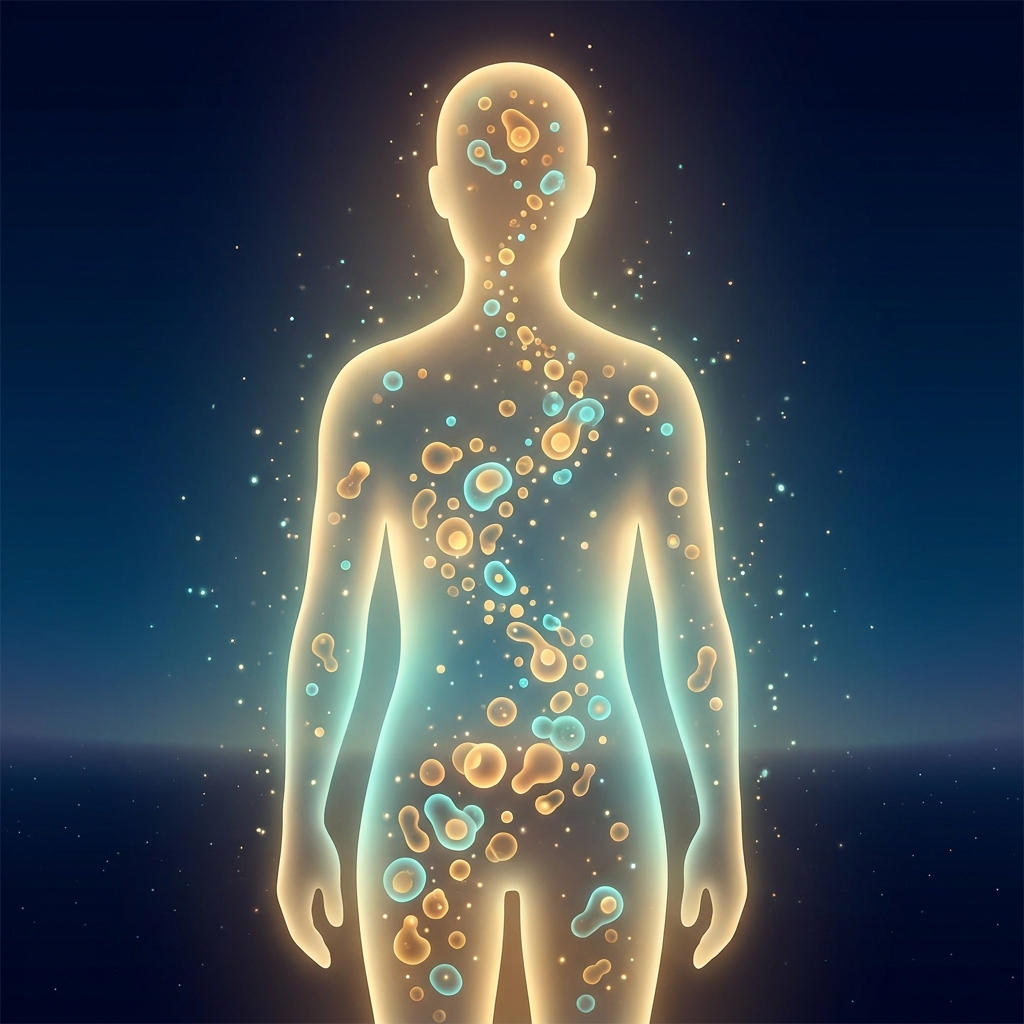
Adult stem cells are the body’s primary repair mechanism, replacing damaged or dying cells throughout tissues. Repair happens in two phases: first, stem cells must be released from bone marrow into circulation; second, they must migrate to and engraft in damaged tissue. The number of circulating stem cells therefore serves as a practical proxy for repair capacity, and increasing that count naturally is a quantifiable longevity strategy.
A landmark mouse study found that mobilization-based transplantation of young-donor hematopoietic stem cells extended median lifespan by 12% and lowered mortality hazard (HR: 0.42), the first direct evidence that stem cell mobilization can extend mammalian lifespan.
One distinction is critical: endogenous stem cell mobilization (supporting the body’s own cells through nutrition) is fundamentally different from exogenous stem cell injection therapy. ESCM introduces no foreign cells. A 2025 Springer Biogerontology editorial noted that animals with extreme longevity often retain robust regenerative ability tied to their stem cell systems. For a deeper look at how regulatory frameworks shape stem cell therapies, Dr. Mukesh Kumar’s overview of stem cells and the FDA provides useful context.
The L-Selectin Ligand Mechanism: How Plant Compounds Trigger Bone Marrow Stem Cell Release
L-selectin is an adhesion protein on the surface of stem cells that anchors them to bone marrow. When specific plant ligand compounds block L-selectin, stem cells detach and enter the bloodstream, where they can travel to sites of damage.
The most documented natural L-selectin ligand is AFA (Aphanizomenon flos-aquae) blue-green algae. Human studies show AFA extract triggers roughly a 25% rise in circulating stem cells within one hour. This is not marketing language: the mechanism is protected by USPTO patents (US7651690, US7947284).
A second validated mobilizer is sea buckthorn berry proanthocyanidin extract. A randomized, double-blind, placebo-controlled crossover trial showed 500 mg caused rapid, selective mobilization of multiple stem cell types within 1 to 2 hours. This mechanism is specific, measurable, and reproducible, and it is almost entirely absent from competitor content.
The Three-Phase Model of Stem Cell Support: Why Single-Ingredient Approaches Fall Short
Comprehensive stem cell support spans three phases:
- Phase 1: Release. Stem cells must be liberated from bone marrow via botanicals acting on L-selectin. Without release, no downstream benefit is possible.
- Phase 2: Mobilization. Released cells must navigate the bloodstream. Microcirculation support (fibrinolytic enzymes, nitric oxide precursors, and vascular botanicals) enables effective delivery.
- Phase 3: Signaling. Excess inflammatory cytokines create “noise” that disrupts the signals guiding stem cells home. Reducing this via COX-2 and 5-LOX inhibition improves homing.
Most supplements address at most one phase, often with a single ingredient at an unvalidated dose, which explains their limited real-world impact.
A Tiered Evidence Framework: How to Evaluate Any Longevity Supplement
A simple tiered framework helps consumers separate clinically validated ingredients from unproven ones.
Tier 1: Replicated Human RCTs with Measurable Stem Cell Outcomes
Tier 1 ingredients are backed by randomized, double-blind, placebo-controlled human trials measuring circulating stem cell counts. AFA extract qualifies (approximately 25% increase within one hour, patent-backed). So does sea buckthorn berry proanthocyanidin extract, via the 2019 trial at 500 mg. Tier 1 also requires the right dose: AFA validation sits at 1,000 mg. The NAD3® study demonstrates this rigorous methodology being applied to newer research.
Tier 2: Promising Human Studies Without Full Replication
Tier 2 ingredients have at least one relevant human study but lack independent replication. Fucoidan (documented at 250 to 3,000 mg) fits here, as do NAD+ precursors like NMN and NR for stem cells specifically. These may be genuinely beneficial; consumers simply accept more uncertainty about magnitude.
Tier 3: Emerging, Preclinical, or Mechanism-Adjacent Ingredients
Tier 3 ingredients have biological plausibility from animal or in vitro work but lack robust human evidence for stem cell mobilization. Certain forms of resveratrol, spermidine, and adaptogens fall here for this mechanism. Readers should ask: What mechanism does it act on? Is it documented in human trials? Is the dose consistent with those trials?
The Dosing Problem: Why the Right Ingredient at the Wrong Dose Does Nothing
Dosing thresholds are among the most exploited issues in this space. Below a therapeutic threshold, an ingredient may produce no measurable effect regardless of its validation at higher doses. AFA’s mobilization is documented at 1,000 mg, yet many products include just 50 to 200 mg. Fucoidan effects appear between 250 and 3,000 mg. Sea buckthorn’s RCT used 500 mg, and sourcing matters as well: high-altitude varieties differ in bioactivity from Mediterranean ones.
Consumers should favor products that disclose individual doses rather than proprietary blends.
Sourcing and Processing: The Hidden Variable in Botanical Stem Cell Mobilizers
Botanical compounds are not chemically uniform. Concentrations of proanthocyanidins, L-selectin ligands, and fucoidans vary with altitude, climate, harvest timing, and processing. Sea buckthorn grown in cold, high-altitude environments like the Tibetan Plateau develops higher stress-response bioactives. AFA from Klamath Lake, Oregon, was the subject of the L-selectin research; other sources may differ. Extraction temperature and fractionation determine whether the final ingredient retains the molecular structures responsible for mobilization. In a fragmented market with over 3,200 startups and no company above 5% market share, sourcing specificity is one of the few defensible differentiators.
How STEMREGEN® Applies the ESCM Framework: A Mechanism-First Case Study
STEMREGEN® offers a useful case study in mechanism-first design. Its founder, Christian Drapeau, MSc (Neurophysiology, Montreal Neurological Institute), coined the term Endogenous Stem Cell Mobilization and has dedicated more than 20 years to this field.
The Release formula features clinically documented ingredients: StemAloe® (+80% circulating stem cells), SeaStem™ sea buckthorn extract (+35%), and StemAFA™ AFA algae (+25%), each sourced from specific locations (Madagascar, Tibetan Plateau, and Klamath Lake). Mobilize addresses Phase 2 using nattokinase, NAC, Ginkgo Biloba, and beetroot with L-Citrulline. Signal addresses Phase 3 via Bromelain, Curcumin, Spirulina Phycocyanin, and Astaxanthin. The Release SPORT variant carries NSF Certified for Sport and WADA compliance, a rare third-party certification in this category.
A 2026 Innerbody Research review identified STEMREGEN as the category leader, noting its ingredients align closely with published clinical thresholds. This is offered not as an endorsement but as a concrete benchmark.
What the Science Cannot Yet Promise: Honest Boundaries of Supplement Longevity
Credibility requires honesty about limits. The 12% mouse lifespan extension is significant but relied on young-donor HSC transplantation, not dietary supplementation. Human studies clearly demonstrate measurable increases in circulating stem cells within hours, but long-term tissue repair, disease prevention, and human lifespan effects remain to be established. The 2026 reversal-of-aging research is exciting but early-stage.
Supplements are best understood as support tools for existing biology, not pharmaceuticals. They rank third behind diet and exercise for a reason and work best alongside sleep, anti-inflammatory nutrition, and regular physical activity. Understanding this realistic scope helps consumers recognize genuinely evidence-based products.
Practical Guidance: Applying the ESCM Lens to Supplement Choices
When evaluating any longevity supplement, consumers should apply the following checklist:
- Mechanism specificity: Does it name a specific mechanism (e.g., L-selectin ligand mobilization) rather than vague “cellular health” claims?
- Human clinical evidence: Is there at least one RCT measuring a relevant biomarker per key ingredient?
- Dose transparency: Are individual doses disclosed and aligned with cited studies?
- Sourcing specificity: Are geographic source and processing disclosed? Are trademarked ingredients used?
- Three-phase coverage: Does it address release, microcirculation, and signaling?
- Third-party verification: Is there independent certification such as NSF Certified for Sport?
No supplement should be judged in isolation from lifestyle. Pairing any stem cell support protocol with superfoods you should be eating and consistent movement will amplify the biological foundation these products are designed to support.
Conclusion: Stem Cell Science Doesn’t Change Everything; It Clarifies Everything
The longevity supplement space is not short on products; it is short on mechanistic clarity. Stem cell exhaustion as a recognized integrative hallmark, and endogenous stem cell mobilization as a measurable target, provides the biological anchor that turns supplement evaluation from guesswork into informed decision-making.
The key insights hold together: stem cell exhaustion sits downstream of all other aging processes; the L-selectin ligand mechanism offers a specific, human-validated pathway; dosing and sourcing are non-negotiable; and the three-phase model explains why single-ingredient products underperform. The realistic goal is not adding years to life but adding life to years. As this market approaches $14 billion by 2030, those who understand the biology will be best positioned to separate genuine innovation from sophisticated marketing.
Ready to Explore Stem Cell Mobilization?
For readers who want to apply the ESCM framework directly, STEMREGEN® is the brand built specifically around the science covered here, founded by the researcher who coined the term and backed by more than 20 years of dedicated research.
Its three-product system (Release, Mobilize, and Signal) implements the three-phase model, with each product addressing a distinct phase of stem cell support. A 30-day money-back guarantee on initial orders offers a low-risk entry point. Readers can visit stemregen.co to explore the full line, review the science behind each ingredient, and access educational resources including the founder’s book Cracking the Stem Cell Code.
Healthcare practitioners can request a discovery call (via Google Meet, 30 to 45 minutes) and access wholesale pricing, making STEMREGEN® a credible option for integrative and functional medicine practices.