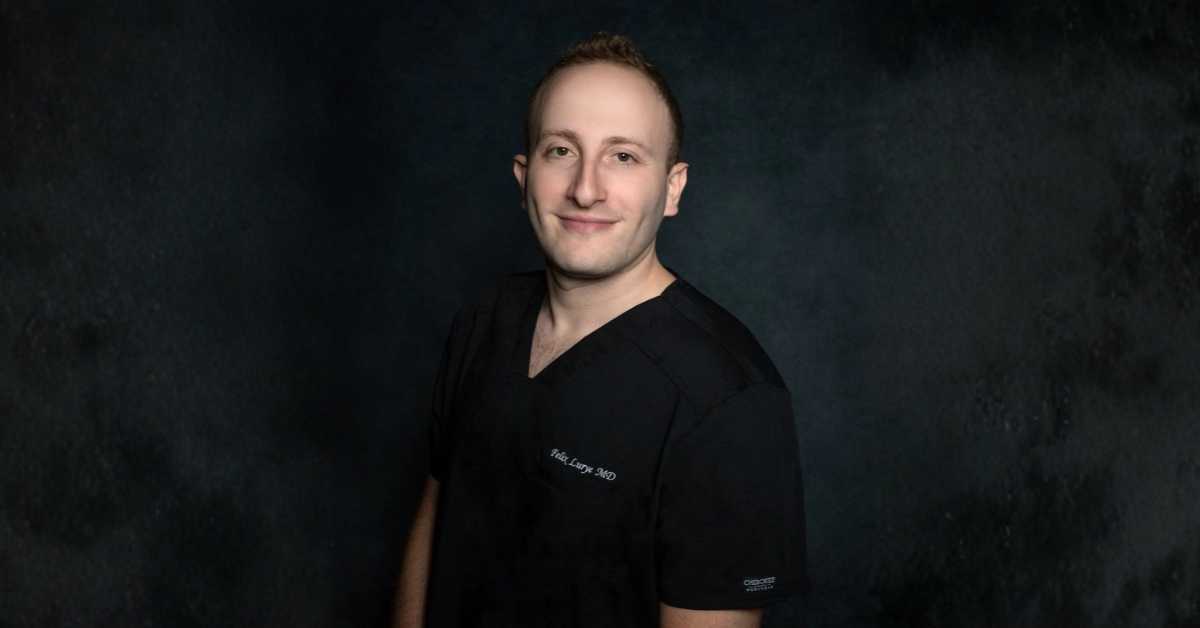
For Dr. Felix Lurye, meaningful pain care begins with a practical question: What has pain taken away from this person, and how can treatment help restore it? Whether the goal is returning to work, sleeping comfortably, or remaining independent, he measures progress through the life a patient can live.
Dr. Lurye, a physician in interventional pain management and the chief executive officer of HarmoniXCell, brings that focus to regenerative medicine. His interest in emerging therapies is accompanied by an insistence on transparent sourcing, realistic expectations, and patient education. In this conversation, he discusses the experiences that led him into legislative advocacy, the limitations of regenerative treatments, and why restoring function requires more than a procedure.
You were instrumental in conceptualizing and championing Florida’s stem cell legislation. What inspired you to pursue this mission?
It started with a Friday night phone call, and it wasn’t my idea. I was just the champion.
Lisa Speer and I have been treating patients together for years. We saw outcomes that convinced us this field deserved a responsible path forward—she’s an RN, my partner in this work, and she’s been beside me clinically through it all.
We had also both been watching the same thing happen, and neither of us had said it out loud. Americans were leaving the country for treatment. Not just a few; a steady stream. They would fly somewhere, receive something, and come home with no idea what had been put into their body. No manufacturing standard. No product characterization. No accountability if something went wrong. Some of them did well. Some of them came back to us with problems, and we couldn’t even tell them what they’d been given.
Lisa called me that Friday night and said, essentially, we know this is wrong, so what are we going to do about it? Not a complaint, but a question that expected an answer. Nurse to Doctor: What are we going to do? That call is the origin of the law.
We saw that the problem wasn’t access. Patients already had access; they just had to get on a plane to use it. The problem was that nobody had set a standard. If you want people to stop seeking care in places with no oversight, you have to build something better at home, and you have to write the rules down.
Walk us through how an idea on a Friday night became state law.
Slowly, and with a lot of people who knew things we didn’t.
We started by building a team and being honest that we were clinicians, not legislators. We had to learn how a bill actually moves—what the steps are. The key component of my participation was educational in nature. We spent real time on that before we spent any time writing, and we had a great advisory team.
We chose Florida deliberately. Our reasoning was about the patient population: Florida has the demographic that carries the heaviest burden of degenerative orthopedic disease and chronic pain, and the most people traveling abroad out of frustration. If you want a law to serve patients, put it where the patients are.
You don’t push through a wall by yourself. You find people who’ve been through that wall before and ask them how. We were repeatedly told that two clinicians with no legislative background wouldn’t get a bill passed. That was reasonable advice.
We brought the vision to the Florida Medical Association because we weren’t interested in doing this “back alley” with organized medicine. We wanted physicians to look at it and tell us whether it was sound.
From there, we were guided to Senator Jay Trumbull and Chairman James Buchanan in the House, who carried it and improved it. We sourced laboratories, built relationships with accredited facilities, and gathered endorsements from business leaders who understood what we were trying to build. And yes, there was an economic study—a legislature is entitled to know what a bill does to a state’s economy.
But the economics were never the argument. Patient safety, patient education, and product quality were the argument. Everything else was in service of those three.
Governor DeSantis was willing to hear it. He engaged with the substance, understood that this was about empowering Florida’s citizens with both choice and protection, and signed it. It took effect July 1, 2025.
The Florida law was landmark, and several states have used it as a blueprint. What is your hope for stem cell use in this country?
It passed the Senate 37–0 and the House 112–0. Not a single vote against it, in either chamber, in this political era. That tells you something about what was actually in the bill. Nobody could find a patient-protective reason to oppose it.
Georgia and Tennessee enacted laws in May of this year. Wyoming’s took effect in July. Others are moving. What I hope spreads is the architecture, not just the permission—accredited sourcing, verified product, honest advertising, real informed consent. Some states have taken Florida’s opening and left out Florida’s guardrails, and that worries me more than the states that have done nothing.
My hope is that regenerative medicine becomes neither a luxury available only to the wealthy nor a desperate gamble taken by people who have run out of options. I want patients across the country to have access to responsible, physician-led care built on transparent sourcing, meaningful consent, appropriate oversight, and honest discussions of what is known and what remains uncertain.
I also hope states continue learning from one another. A strong national future will require shared expectations for product integrity, adverse-event reporting, physician education, patient follow-up, and truthful marketing. Access matters, but access without reliable information is not genuine choice.
Our dream is the one Lisa and I articulated at the beginning: to democratize this. Safe alternative treatment should not be something available only to people who can afford an international flight and a cash-pay clinic abroad. That is not a healthcare system. That is a sorting mechanism. If this field becomes accessible, affordable, and honestly regulated, it will have earned its place in American medicine. If it stays expensive and unaccountable, it won’t deserve one. The ultimate goal is to democratize safe, affordable regenerative care while continuing to strengthen the evidence.
Why was creating legal standards just as important as advancing the science?
Because a therapy is only as good as the product in the syringe, and for years nobody was required to prove what was in it. Science tells us what may be possible. Standards determine whether patients can explore those possibilities responsibly. Without clear rules, patients may not know the difference between high-quality physicians and laboratories and actors making unsupported promises.
That was the whole insight behind the bill. We had both seen patients who received something—and “something” is the precise word, because nobody could tell us what.
So look at what Florida now requires. The cells must come from an FDA-registered facility accredited by the National Marrow Donor Program, the World Marrow Donor Association, AABB, or the American Association of Tissue Banks. We hope to add another elevated accrediting entity: the American Academy of Stem Cell Medicine. The entities require on-site lab inspections. Current good manufacturing practices. A post-thaw viability analysis for that specific lot, handed to the physician before use. A signed informed consent that spells out risks, alternatives, and the option of no treatment at all. And a mandated disclosure in any advertisement stating the therapy is not FDA-approved.
None of that is science; It’s all the difference between medicine and commerce.
I’ll say one thing plainly, because it gets misrepresented constantly: This law does not make any therapy FDA-approved, and it does not displace federal law. It sets conditions. Any clinic telling patients that Florida “approved” their treatment is misusing the legislation.
How has the legislation established higher standards for safety, transparency, and physician accountability?
Three ways, and each maps to something we’ve watched go wrong.
Safety—The sourcing and manufacturing requirements create a paper trail. The post-thaw viability report is the provision I’d point to first. It forces somebody to verify that the cells are alive and countable before they go into a human being. That sounds elementary. It was not happening.
Transparency—The advertising disclosure was the provision the industry liked least. We wanted it anyway.
Accountability—The law reaches only licensed MDs, DOs, and DPMs; only within their scope of practice and training; and only for orthopedics, wound care, and pain management. That means there is a license at risk and a board with jurisdiction. A patient who is harmed has somewhere to go. Before, in too many cases, they had nowhere to go. We are hoping to add Nurse Practitioners who also possess a specialized scope.
Why are we at a turning point in regenerative medicine, and what should patients know?
Three things converged. Manufacturing science has improved to the point where consistency is achievable, not aspirational. The regulatory conversation moved from prohibition toward conditional frameworks. And an enormous cohort of patients aged into degenerative disease with a treatment menu that ends at surgery.
We are at a turning point because advances in cell biology, tissue processing, imaging, manufacturing, and outcomes tracking are beginning to converge. Physicians can ask more precise questions about how the body responds to injury, inflammation, and degeneration, while researchers have better tools to measure those responses. Public interest is also forcing medicine to address the limits of treatments that manage symptoms without restoring function.
What patients should know is more sober than the headlines. This is a field with real promise and an uneven evidence base. Some applications have randomized support. Others have case series and enthusiasm. A turning point is not a finish line, and I’d rather a patient hear that from me than learn it after writing a check.
How can patients distinguish evidence-based regenerative medicine from exaggerated marketing?
Look at the indication list. A clinic offering the same injection with the same dosing for arthritis, autism, MS, and anti-aging is selling a product, not practicing medicine. Biology doesn’t work that way.
Listen for guarantees. No legitimate physician guarantees a result. If someone quotes a success rate without a citation, ask for the citation. This treatment is not a cure—if they promise a cure, walk away.
Watch for pressure. Expiring discounts and financing pushed before diagnosis are sales tactics with no place in a clinical encounter.
Check who’s holding the needle. In Florida, it must be a licensed MD, DO, or DPM, within their scope and training.
Read the ad itself. Florida requires a specific disclosure that the therapy is not FDA-approved. If it’s missing, that provider is out of compliance with the law in the state where they’re operating—and you should wonder what else they’re skipping.
How do stem cells, exosomes, and other regenerative therapies work together?
I want to be careful here, because this is where the field’s marketing has run furthest ahead of its data. These therapies are related, but they are not interchangeable.
The premise is that these therapies work less by replacing tissue than by signaling. Mesenchymal cells appear to act largely through paracrine effects—releasing growth factors and modulating the local inflammatory environment—rather than differentiating wholesale into new cartilage. Extracellular vesicles, including exosomes, are one vehicle for that signaling.
That’s the mechanism as currently understood. The clinical translation is at very different stages. Exosome products specifically are not FDA-approved for any indication, and the FDA has issued public safety warnings about unapproved exosome products following adverse events. I don’t market them as proven, and I’d encourage patients to be skeptical of anyone who does.
The honest statement: The signaling model is well supported in the laboratory. The clinical evidence varies enormously by application, and the gap between those two facts is exactly where patients get hurt.
What would you say to physicians who remain skeptical?
That their skepticism is doing its job, and I’d rather practice alongside them than alongside a true believer. Healthy skepticism is essential to good medicine.
I’d only ask them to aim it precisely. “Regenerative medicine” is not one thing. It spans a well-characterized autologous preparation for knee osteoarthritis and an unaccredited vial of unknown content sold for a neurologic disease. Skepticism aimed at the whole category treats those as equivalent, and they are not.
Read the orthopedic literature the way you’d read it for any intervention. You’ll find encouraging signals, heterogeneous preparations that make trials difficult to compare, and real methodological weakness. All of that is true at once.
The colleagues who’ve changed my thinking most are the skeptical ones who engaged with the data instead of dismissing the field. If the science is right, it survives that. If parts of it are wrong, I want to know before I’ve treated another thousand people.
If healing had a voice, what would it say to modern medicine?
Probably that it was here first.
The body was repairing itself long before any of us showed up, and most of what we do works by removing an obstacle to that process or getting out of its way. Surgeons don’t heal incisions. They approximate the edges, and the patient does the rest.
I think healing would ask for less interference and more attention. And it would ask us to be honest about how much of what we take credit for was never really ours.
Modern medicine is extraordinarily powerful, but healing would remind us that our job isn’t only to fight disease—it is also to create the conditions for function, resilience, and quality of life to return.
Explain what a stem cell does using an analogy that has nothing to do with medicine.
Think about a neighborhood that’s slowly deteriorated—boarded windows, no maintenance, nobody investing. You could demolish it and rebuild; that’s surgery, and sometimes it’s exactly right.
Or you could send in a small team whose job isn’t construction but coordination. They don’t build the houses. They assess the block, get the utilities back on, quiet down whatever’s been making the street uninhabitable, and signal to the people still living there that repair is worth doing. The rebuilding is done by the residents. The team changed the conditions that made rebuilding possible.
That’s much closer to what the evidence suggests these cells do. And it carries the limitation honestly: If there are houses still standing, you have something to work with. If the block has been razed, no amount of coordination brings it back—and that’s a patient who needs a surgeon and deserves to be told so.

ABOUT MICHELE HUGHES
Michele Hughes is VP of Business Development at Longevity Masters Global, an exciting new startup founded by Rob Fletcher that brings together many of the world’s leading experts in longevity, health optimization, wellness, recovery, and peak human performance.
She is also the visionary founder of Ageless and Timeless and the dynamic host of the Ageless and Timeless Podcast®. As a monthly contributor to TopDoctor Magazine, Michele offers powerful insights on wellness, longevity, and living fully at every stage of life. With a deep passion for health and vitality, and serving as a role model for timeless elegance, she empowers audiences to embrace their highest potential and live with purpose and grace.
The Ageless and Timeless Podcast® was one of only 20 inaugural podcasts selected for the Muscle & Fitness+ platform when it launched in 2023, further expanding Michele’s reach as a trusted voice in the longevity and wellness space.
For more information, to express interest in being a guest on the Ageless and Timeless Podcast®, to be featured in Michele’s TopDoctor Magazine column, or to inquire about podcast collaborations or having Michele Hughes as a guest on your show, please contact:
Email: themichelehughescompany@gmail.com
Website: www.agelessandtimeless.com
Instagram: @agelessandimeless
LinkedIn: https://www.linkedin.com/in/michele-hughes-83a3b935/
Facebook: https://www.facebook.com/michele.hughes.186
Ageless and Timeless podcast, on YouTube, iTunes, Spotify, and wherever podcasts are available.