
A password can be changed. A credit card can be canceled. Your genome cannot.
That simple reality may become one of the most important considerations facing physicians as artificial intelligence moves deeper into personalized medicine. Clinicians can now combine lab results, medical histories, medications, lifestyle information, and genetic data on platforms that find relationships across thousands of data points in minutes, not hours.
The potential is extraordinary. But the more powerful these systems become, the more important a second question becomes: Where does all that data go? When the data includes a patient’s DNA, the answer matters long after the test is complete.
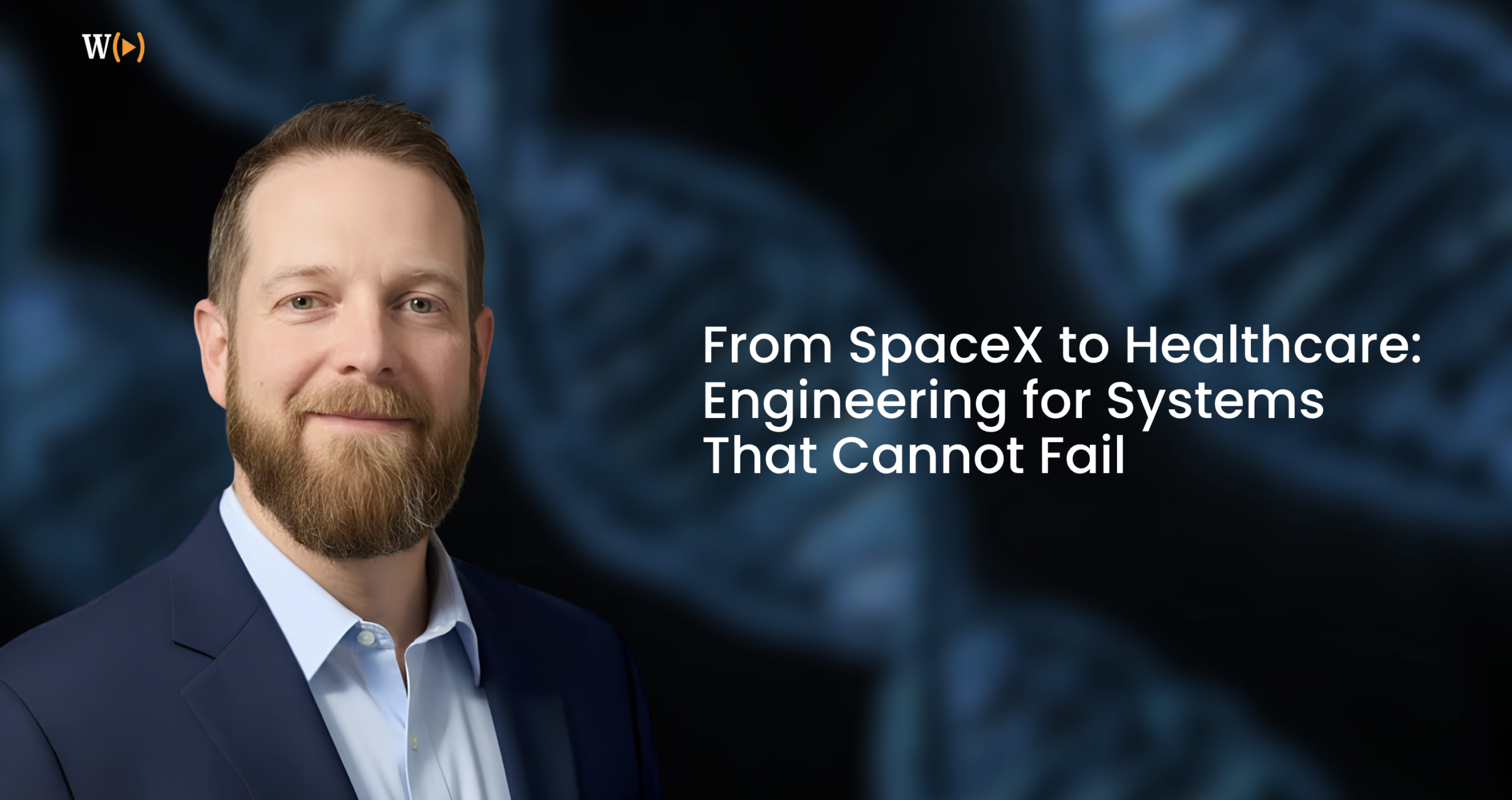
From SpaceX to Healthcare: Engineering for Systems That Cannot Fail
John Whitman has spent much of his career on systems that cannot afford to fail. Before co-founding Nexus Health, he was a Principal Systems Engineer at SpaceX, where, according to the company, he built infrastructure supporting launch systems, Starlink and Starbase. His background also includes large-scale data centers and federal-compliance environments.
He brought that mindset to a healthcare problem that was never about a shortage of data. Labs lived in one system, genetics in another, histories somewhere else. Nexus Health was built to cross-analyze DNA, lab results, and intake data so clinicians can see multi-system patterns in a single case view.
But a system that sees a patient’s labs, history, and genome together holds an extraordinarily revealing picture of that person. Protection therefore has to be engineered into the architecture, not added afterward as a policy.
Safety by Design: The Nexus Health Model
Nexus Health publishes its safeguards instead of asking clinicians to take them on faith. According to its Privacy & Security page and platform materials, the system includes:
- Encryption with AES-256 at rest and TLS 1.3 in transit
- Access controls that are role-based, with audit logging and a full audit trail on clinical actions
- Identity protection through PII scrubbing and pseudonymization of sensitive information
- Independent attestation, listed as SOC 2 Type 2, alongside HIPAA safeguards, and Business Associate Agreements where applicable
- A private AI engine with session-bound data use: Patient data is processed for the active clinical case and, the company says, is not retained or mined
- Patient control, including no sale or sharing of personal health data, and the ability to export or delete it
Most important for the AI conversation, Nexus states that patient data processed by its underlying AI providers is covered by zero-data-retention agreements and is not used to train those foundation models. That distinction deserves attention. Letting a model process patient information for a defined clinical purpose is fundamentally different from letting that information become material used to build or improve the model.
Nexus also keeps a clinician between the algorithm and the patient. The platform identifies patterns, flags interactions, and proposes protocols with the reasoning shown, but no protocol, insight, or recommendation reaches a patient without practitioner review and sign-off.
So the question for physicians is no longer only how intelligent is your AI? It is also how safely did you engineer the system around it?
Your Genome Has a Supply Chain
When a patient spits into a tube, the transaction looks simple: order a test, send the sample, receive a report. Behind it there may be several custodians of that patient’s biology: the company that sells the kit, an independent lab that processes the sample and may retain it under its own policies, an interpretation service, a cloud host, research partners and, increasingly, an AI provider.
Many consumer genetic-testing notices disclose exactly this arrangement, along with the use of de-identified genetic data for research and product development. None of that is inherently improper. It does mean deletion from one system is not deletion everywhere. If a patient says, “Delete my DNA,” who actually has to delete it?
It also means terms like “de-identified,” “anonymized,” and “pseudonymized” need definitions, not assumptions. DNA is inherently identifying, so removing a name is not the same as removing the person.
Medicine may need a new rule for evaluating genetic technology: Don’t just ask who performs the test. Follow the genome. Who collects it, sequences it, keeps the physical sample, holds the raw file, writes the interpretation, and may use it for research or feed it to AI? The answers can reveal as much about a platform as the sophistication of the test itself.
“HIPAA Compliant” Is the Beginning of the Conversation
One of the first questions a physician asks a technology vendor is whether it is HIPAA compliant. It is an important question, but it is not enough.
HIPAA sets privacy and security obligations for covered entities and their business associates. A vendor that handles protected health information on behalf of a practice may be a business associate and need a signed agreement. But not every company holding health-related information falls under HIPAA, and consumer genetic data may be governed by other federal and state laws depending on who holds it and how it was collected.
The better question is: What legal, contractual, and technical protections apply to my patient’s information at every stage of its lifecycle?

The Genome Test: 10 Questions Every Doctor Should Ask
Before sending genomic or other highly sensitive patient information into an AI-enabled platform, ask every vendor these questions. The right column shows what a strong, published answer looks like, using Nexus Health as the benchmark.
# | Ask | What a strong answer looks like (Nexus Health) |
1 | Who receives the data? | A named list of subprocessors, and a commitment not to sell or share personal health data. Nexus makes that commitment; ask any vendor for its subprocessor list. |
2 | Is patient data used to train AI? | A clear no that covers training, fine-tuning, and product improvement. Nexus states patient data is not used to train foundation models. |
3 | Does the AI provider retain anything? | Zero-data-retention agreements with every model provider. Nexus states these are in place. |
4 | Where is it stored? | Locations and jurisdictions for primary data, backups, and logs. Request this in writing from any vendor. |
5 | How is it encrypted? | Specific standards, not “bank-grade.” Nexus cites AES-256 at rest and TLS 1.3 in transit. |
6 | What happens to identifying information? | Defined terms and a described method. Nexus describes PII scrubbing and pseudonymization. |
7 | Will you sign a BAA? | Yes, when required, in addition to independent attestation. Nexus offers BAAs where applicable and lists SOC 2 Type 2. |
8 | Can the patient export and delete it? | Self-service export and deletion, with clarity on backups, samples, and subprocessors. Nexus provides in-account export and delete. |
9 | What if the company is acquired? | Contract terms that bind any successor to the same protections. Ask every vendor, including Nexus. |
10 | Does a clinician stay in control? | Required review and sign-off, with reasoning shown. Nexus requires clinician approval before anything reaches a patient. |
And perhaps an eleventh: Would the people who built the platform trust it with their own genomes?
A benchmark is not a blank check. Physicians should not trust one company’s claims over another’s; they should demand the same answers, in writing, from everyone.

Your Genome Is Different
Genomic information deserves special consideration because it is effectively permanent. The Genetic Information Nondiscrimination Act (GINA) restricts certain uses of genetic information in health insurance and employment. But GINA does not extend the same protection to life insurance or long-term-care insurance. Patients deserve to understand those limits before assuming their genetic information is protected everywhere and forever.
Trust May Become Healthcare AI’s Most Important Feature
The next generation of healthcare AI will be judged on intelligence: how much it can analyze, how fast it finds meaningful patterns, and how well it helps a clinician understand a complicated patient. Medicine should demand one more measure: Can we trust the infrastructure holding the human being behind those data points?
Companies like Nexus Health are making data architecture a visible part of the product, answering publicly on AI-provider retention, model training, encryption, BAAs, and clinician control. That is the standard. Genetic testing companies, laboratories, clinical AI platforms, and data processors should all be asked to meet it.
The future of personalized medicine depends on combining extraordinary amounts of biological information. The future of patient trust depends on what we choose to do with it.
A password can be changed. A credit card can be canceled. Your genome cannot.