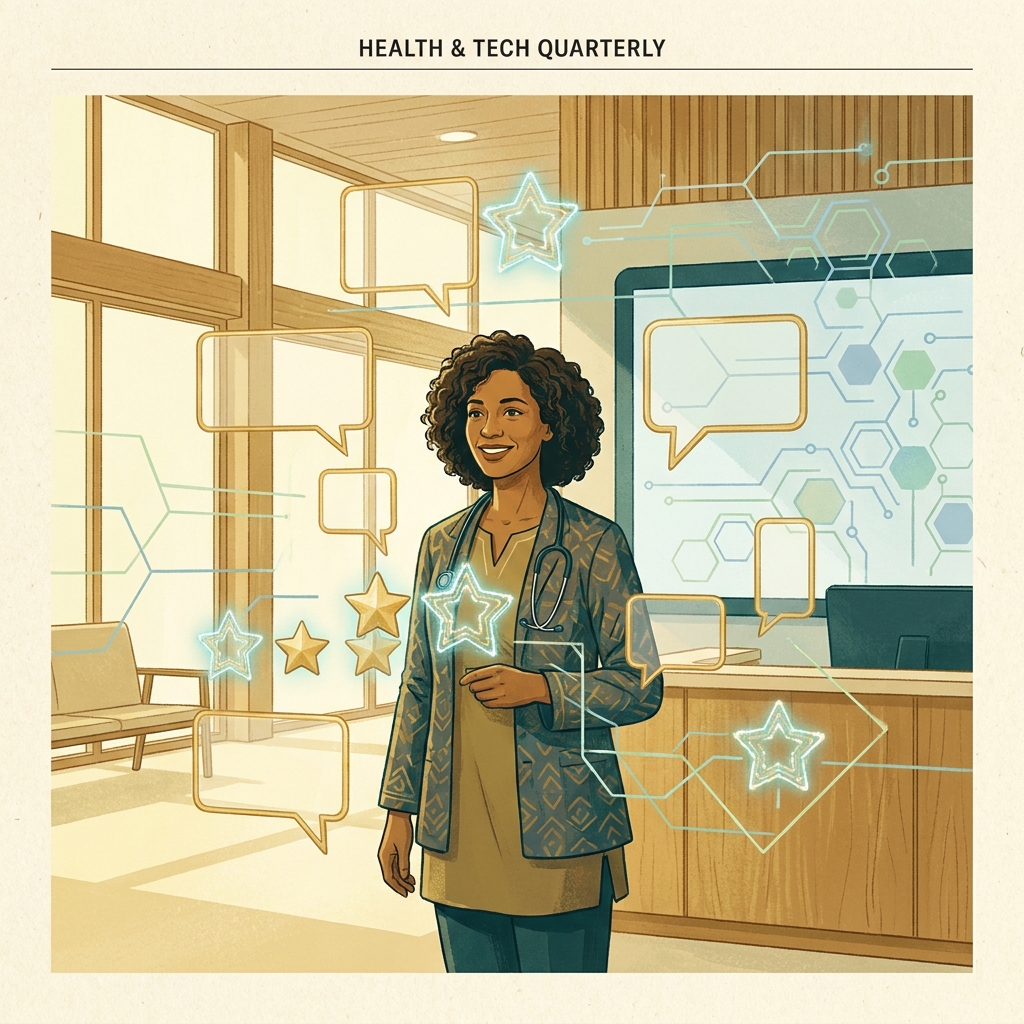
Patient Testimonial Doctor Trust Building: How Structured Patient Feedback Shapes Physician Reputation in the AI Era
Introduction: The New Currency of Physician Trust
In 2026, the first conversation a patient has about a physician often happens before the two ever meet. According to the ZS Impact Institute’s 2026 Future of Health Report, 84% of patients check online reviews before booking a healthcare provider, making patient testimonials the dominant pre-visit trust signal, more influential than hospital affiliations or academic credentials alone.
This shift arrives at a precarious moment. Institutional trust in doctors and hospitals fell from 71.5% in April 2020 to just 40.1% by January 2024, according to JAMA Network Open data. Yet trust in one’s own physician has remained comparatively resilient. That gap creates a rare and valuable window: individual physicians can rise above the systemic noise by building a strong personal reputation.
The central argument of this article is straightforward. Patient testimonials are no longer simply marketing tools. They have evolved into credibility architecture that both human patients and AI-powered search engines actively surface, summarize, and use to recommend physicians. Within that ecosystem, a critical distinction is emerging between anonymous consumer reviews and structured, verified testimonials collected through formal programs like the TopDoctor Magazine Awards. This piece explores the emotional, strategic, and technological dimensions of that shift, and what physicians can do to proactively shape their reputation.
The Trust Crisis in American Healthcare: Why Individual Physician Reputation Has Never Mattered More
The scale of the trust collapse is difficult to overstate. A January 2025 Gallup poll cited a 14% decline in physician trust between 2020 and 2024, while trust in one’s own doctor slipped from 93% in 2023 to 85% in early 2025, according to KFF.
The important nuance, however, is where the distrust is aimed. The crisis is directed primarily at the healthcare system, not at individual providers. That distinction creates a meaningful opportunity for differentiation through personal reputation building.
The stakes are quantifiable. The Qualtrics 2026 Healthcare Experience Trends Report, based on 60,463 U.S. patients, found that trust is the number one driver of patient experience, producing a 75-point NPS gap between high-trust and low-trust patients, the largest swing of any single variable measured.
Trust has also moved from soft concept to hard metric. The American Board of Family Medicine and the American Board of Internal Medicine are now formally measuring physician trust using the Wake Forest Trust Measure within the PRIME Registry. Physicians who proactively build verified, structured testimonial records are positioned to stand apart and capture patients actively seeking trustworthy individual providers.
How Patients Actually Evaluate Physicians in 2026: The Data Behind the Decision
Patients now shop for doctors the way they shop for products, comparing ratings, reading reviews, and seeking social proof before committing.
The threshold effects are sharp. The rater8 2026 Patient Choice Report found that 75% of patients will not book with a provider rated below 4.0 stars, a hard “cliff effect” that turns reputation management into a clinical business necessity. Furthermore, 55% of patients have canceled or avoided booking with a provider because of negative online reviews, a 15-percentage-point increase from 2025 to 2026.
What drives those negative reviews is instructive. The top deal-breakers are operational, not clinical: rude or unhelpful staff (52%), “the doctor didn’t listen” (52%), substandard care (45%), long wait times (41%), and billing issues (40%). Testimonials that specifically highlight listening and empathy are therefore especially powerful differentiators.
Peer testimony outweighs institutional metrics. NRC Health found that consumers use provider reviews 2.75 times more than CMS star ratings when choosing care. The emotional dimension is equally decisive: patients who felt treated as a unique person were 12 times more likely to recommend their healthcare organization, based on NRC Health’s study of more than 300,000 consumers.
AI Has Changed the Rules: How Algorithms Now Evaluate Physician Reputation
The most significant change of 2026 is who, or what, patients consult first. According to rater8 research, 47% of patients used an AI tool such as ChatGPT, Claude, Perplexity, or Google AI Overviews to research healthcare providers in 2026, up from 31% in 2025, a near-doubling in under a year.
Even more striking, among patients who searched for a new doctor in 2026, AI tools were cited as the top digital influence by 36%, ahead of Google search (34%) and physician referrals (32%), as reported by Medical Economics. This marks AI’s first-ever lead over traditional channels.
Physicians must understand that AI systems synthesize and summarize publicly available patient testimonials, review text, and structured data to generate recommendations. The quality, specificity, and volume of testimonials directly shapes what AI tells prospective patients. A vague review such as “great doctor, highly recommend” provides little signal. A specific, narrative-rich testimonial describing a physician’s communication style, expertise, and patient outcomes functions almost like training data, far more likely to be surfaced and summarized.
There is also a generational dimension. Older patients (ages 45 to 60) are now among the heaviest AI-research users, while younger patients are less likely to have an established primary care physician. These are two distinct audiences with different consumption patterns. The strategic implication is clear: physicians who generate structured, detailed, verified testimonials are not merely managing their reputation; they are programming the data layer AI will use to represent them.
Structured vs. Anonymous: Why Not All Testimonials Are Created Equal
Anonymous consumer reviews on Google or general review platforms are self-submitted, unverified, and vulnerable to manipulation. Structured testimonials collected through formal programs involve third-party submission, identity verification, and institutional vetting.
This distinction matters increasingly to AI. Algorithms weight source credibility and structural signals when synthesizing information; testimonials associated with recognized programs, publications, or awards carry more institutional authority than anonymous star ratings.
There is also a participation gap to address. The rater8 2026 report found that 68% of patients say they would leave a review if their doctor asked, yet 42% rarely or never leave reviews. The majority of satisfied patients are silent, and structured programs are uniquely positioned to activate them.
The nomination-based model addresses both problems. TopDoctor Magazine’s awards program requires testimonials to be submitted by a third party, whether another doctor, a patient, or a TopDoctor Magazine representative, adding a layer of social proof and accountability that anonymous reviews cannot replicate.
The transformative potential is documented. NRC Health’s UT Physicians case study showed that publishing verified patient reviews took the practice from a 2.9 to a 4.6 star rating and grew Google reviews by 776% in a single year. Response behavior also matters: 59.48% of patients are more likely to choose a provider who responds to both positive and negative reviews, according to RepuGen.
The Anatomy of a Trust-Building Testimonial: What Makes Patient Feedback Credible and Compelling
A trust-building testimonial is specific, narrative-driven, emotionally authentic, and addresses the physician’s communication style, empathy, and clinical outcomes, not just a star rating.
Because “the doctor didn’t listen” is the top emotional complaint in negative reviews, testimonials that describe a physician’s attentiveness and personalized approach serve as the most powerful counterweight.
Video amplifies all of this. Patient testimonial videos deliver the highest conversion impact of any healthcare content format, increasing landing page conversions by up to 80% through authentic storytelling, according to Think Branded Media. Video content is also increasingly indexed and summarized by AI tools.
AI-friendly testimonials share common traits: detailed, keyword-rich narratives that mention the physician’s name, specialty, specific conditions treated, and patient outcomes. These elements give AI systems the structured data needed to generate accurate, favorable summaries.
For physicians, receiving a heartfelt testimonial is not merely a marketing event; it is a professional affirmation, particularly during a period of systemic trust erosion. Patients are also more comfortable than ever with documented digital communication: patient-written messages to providers through portals increased 153% between 2020 and 2025, per a JAMA study, a behavioral shift that feeds directly into the testimonial ecosystem.
HIPAA Compliance and Testimonials: Building Trust Through Ethical Transparency
HIPAA compliance should be framed not as a legal burden but as a trust-building feature. When patients see that a physician handles their personal information with care, even within a positive testimonial, they receive a powerful signal about how their medical information will be treated.
The core rules are clear. Per Compliancy Group, explicit written authorization is required before using testimonials that include Protected Health Information; de-identified testimonials may be used without consent. Non-compliance penalties can reach $2,067,813 per year for repeated violations.
A compliant process includes written consent forms, clear disclosure of how the testimonial will be used, anonymization options, and secure storage of authorization records. Structured programs like TopDoctor Magazine’s awards process build HIPAA compliance into the nomination workflow, reducing liability while ensuring testimonials can be used across digital platforms.
Compliance also carries algorithmic advantages: AI tools increasingly prioritize verified, consent-based content over anonymous reviews. For physicians, presenting consent as an invitation, such as “we’d love to share your story to help other patients find the right care,” transforms a compliance step into a community-building moment.
Awards Programs as Credibility Architecture: The TopDoctor Magazine Model
Credibility architecture is a structured system of verified testimonials, third-party recognition, and institutional endorsement that functions as a durable, multi-layered trust signal, distinct from the fragile and anonymous nature of consumer review platforms.
Nomination-based awards operate as trust infrastructure. TopDoctor Magazine’s awards require testimonials submitted by a third party, verified patient feedback, and a 30 to 45 minute interview, creating a multi-step vetting process that gives the resulting recognition institutional weight.
The effect compounds. A physician who earns a TopDoctor Magazine award has simultaneously generated verified testimonials, received editorial coverage, been profiled in a credible publication, and created content that AI tools can surface and recommend, all from a single structured process.
This model is already validated at scale. In January 2025, Press Ganey recognized 267 U.S. health systems based on annual feedback from 6.5 million patient encounters, online reviews, and member experience data, demonstrating that institutional awards built on patient feedback represent the gold standard in healthcare recognition. TopDoctor Magazine’s Patient Recommendation category is designed specifically to elevate patient-sourced testimonials as the primary credibility signal, not peer votes or self-nomination.
The Participation Gap: Why Satisfied Patients Stay Silent, and How to Activate Them
Here is the paradox: the patients most likely to have a genuinely positive experience are statistically the least likely to spontaneously leave a review. The data confirms it. While 68% of patients say they would leave a review if their doctor asked, 42% rarely or never do.
The reasons for silence are psychological. Satisfied patients assume their doctor is already well-reviewed. They may not know how to leave a review, feel their experience is private, or simply forget by the time they leave the office.
Structured programs close this gap by giving patients a clear, meaningful reason to share, framing feedback as a contribution to a larger recognition effort rather than a routine consumer review. Practical activation strategies include post-visit follow-up messages explaining the impact of feedback, staff-led prompts at checkout, QR codes linking to submission forms, and personal physician requests during appointments.
Every testimonial submitted through a structured program becomes a permanent, indexed piece of physician reputation data, one that AI tools will continue to surface for future patients long after the appointment ends.
From Feedback to Identity: The Physician’s Experience of Patient Testimonials
Beyond data and algorithms, receiving a detailed patient testimonial is one of the most affirming professional experiences a physician can have: direct confirmation that their work has made a meaningful difference.
In an era when institutional trust has collapsed and physician burnout sits at historic levels, testimonials serve as a counterforce, reminding physicians why they entered medicine. Physicians who regularly review patient feedback develop a clearer, more patient-centered understanding of their own strengths, which shapes how they communicate, listen, and practice.
Research reinforces this. A 2026 Nature study of 2,685 doctors across 16 specialties found that patient feedback is a pivotal factor in shaping trust dynamics in online health communities, and that published articles bolster trust while professional titles alone may paradoxically hinder patient selection. Authentic human connection outperforms credential-listing as a trust strategy.
This creates a virtuous cycle. Physicians who embrace structured testimonial collection become more attentive to the experience dimensions that generate positive feedback. The 30 to 45 minute interview required by TopDoctor Magazine’s awards process becomes a reflective milestone, inviting physicians to articulate their care philosophy and connect their daily work to a larger narrative of excellence. Physicians looking to deepen their understanding of how longevity and quality of life intersect with patient-centered care will find that the same principles driving positive testimonials also underpin long-term patient wellbeing.
Building a Testimonial Strategy That Works in the AI Era
Effective patient testimonial doctor trust building in 2026 requires a three-layer approach: collection, structure, and amplification.
- Collection: Ask patients directly and personally, use post-visit digital follow-up, provide simple submission pathways, and participate in structured programs like awards nominations.
- Structure: Encourage specific, narrative testimonials over star ratings; collect video where possible; ensure every testimonial includes the physician’s name, specialty, and specific experience details AI can index; obtain written HIPAA consent for identified testimonials.
- Amplification: Publish verified testimonials on the practice website, Google Business Profile, and specialty directories; seek editorial coverage in credible publications; pursue nomination-based awards that create indexed, authoritative content.
The response imperative cannot be ignored. According to current data, 66% of patients say a provider’s response to reviews directly influences their trust, a 24-point jump from 2025, making thoughtful, timely responses non-negotiable.
The market context makes early action prudent. The healthcare digital content creation market reached $12.85 billion in 2025 and is projected to grow at over 22% annually through 2035. Physicians who build structured testimonial assets now are investing in a compounding digital reputation that appreciates as AI becomes more central to patient decisions. For physicians seeking to stay current on the evolving landscape of the future of aesthetics and other specialty-specific reputation considerations, understanding how digital trust signals operate across different fields is increasingly essential.
Conclusion: Testimonials Are the Foundation of Physician Trust in the AI Era
In 2026, patient testimonials have evolved from a marketing tactic into the primary data layer that both human patients and AI systems use to evaluate physician trustworthiness. Structured, verified testimonial collection is now a strategic imperative, not an optional enhancement.
The distinctions matter. Anonymous consumer reviews are fragile and algorithmically weak. Structured, verified testimonials collected through formal programs carry institutional weight, AI credibility, and HIPAA compliance, and they activate the silent majority of satisfied patients who would gladly share their experience if given a meaningful reason.
At a moment when systemic trust in healthcare has collapsed, individual physicians have a rare opportunity to differentiate through the authentic, specific, human voices of their patients. The most powerful testimonials are never manufactured; they are the natural result of physicians who listen deeply, communicate clearly, and treat every patient as a unique person. As AI continues to reshape how patients find and evaluate physicians, the doctors who invest in structured, verified, narrative-rich testimonials today are building the reputation infrastructure that will define their practices for the next decade.
Take the Next Step: Build Your Credibility Architecture with TopDoctor Magazine
Physicians ready to move from passive reputation to proactive credibility should explore the TopDoctor Magazine Awards nomination process, particularly the Patient Recommendation category, the most structured, credible, and AI-visible pathway to building a verified testimonial record.
Readers can also nominate a physician they trust or admire, an act of community recognition that gives a deserving doctor’s patients a meaningful platform to share their experiences.
Healthcare professionals and practice managers are invited to subscribe to TopDoctor Magazine’s newsletter for ongoing coverage of physician reputation strategy, patient trust research, and healthcare innovation.
The TopDoctor Magazine awards program is not just a recognition event; it is a structured credibility-building process that generates verified testimonials, editorial coverage, indexed digital content, and a professional profile that AI tools can surface and recommend. With AI adoption among patients accelerating rapidly, from 31% in 2025 to 47% in 2026, the window to shape the testimonial data layer that AI will use to represent a physician is narrowing. Early movers will hold a compounding advantage.