
Peptide Testing Explained: What Independent Labs Check and Why It Matters
A vial of research peptide looks the same whether it holds a pure compound, a half-finished chain or something else entirely. A small white powder gives nothing away. That is why peptide testing exists. It is the only practical way to know what a vial really contains before a lab spends weeks of work on it.
For researchers, testing answers a few plain questions. Is this the right peptide? How much of the powder is that peptide, and how much is something else? Does the amount in the vial match the label? The answers decide whether an experiment’s results can be trusted, repeated and published.
This guide walks through what a testing lab measures, how a sample moves through the lab, and what to look for when you rely on peptide testing done by someone else. It is written for buyers and students who want to understand the process, not for chemists who already run the machines.
What peptide testing actually measures
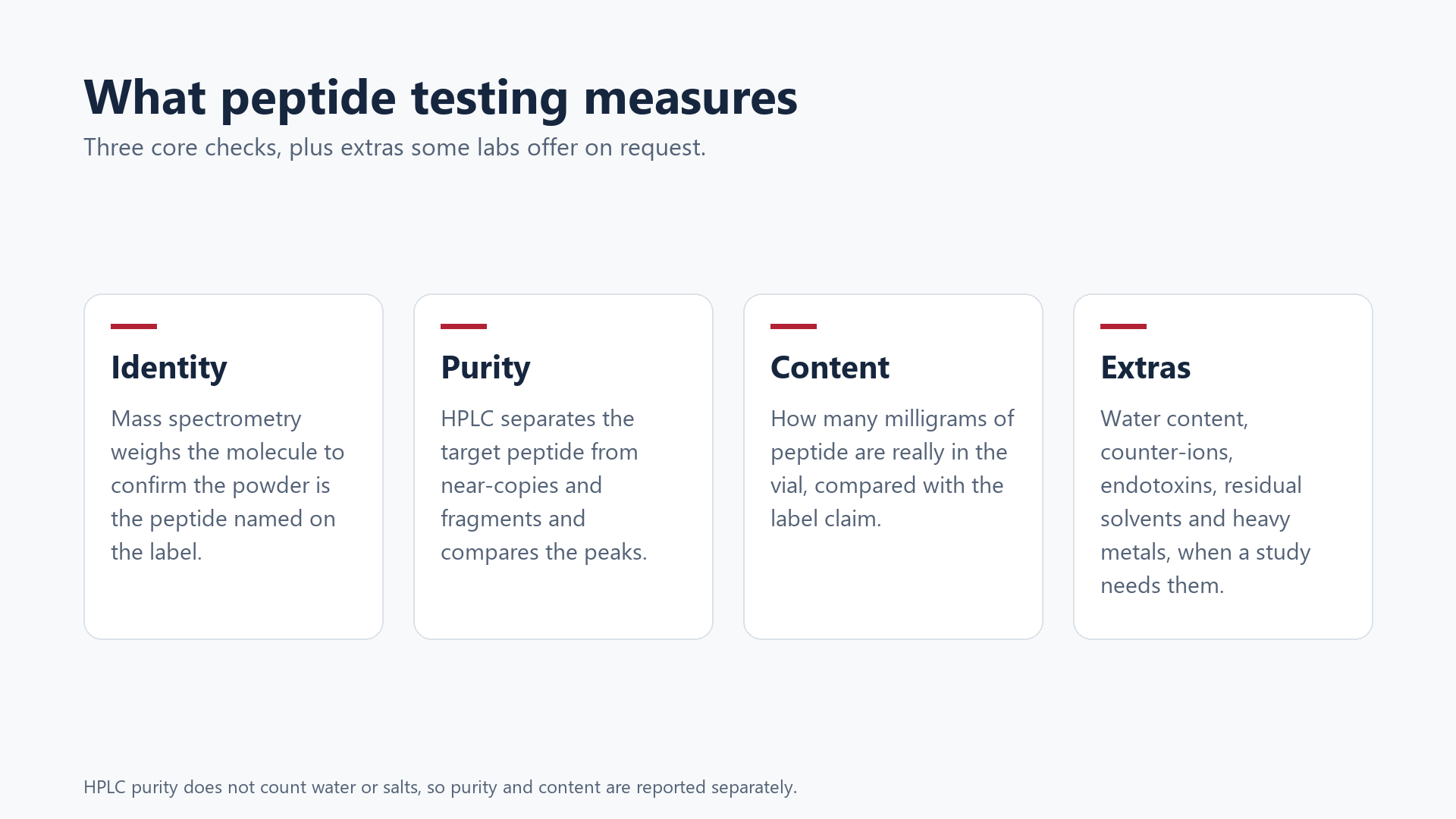
Most peptide testing comes down to three core checks. Each one answers a different question, and none of them can stand in for the others.
Identity. This confirms the powder is the peptide named on the label. Labs usually do it with mass spectrometry, a method that weighs molecules very precisely. Every peptide has a known mass based on its amino acids, so a match is strong evidence the right chain is there.
Purity. This measures how much of the peptide material is the target peptide, compared with near-copies and fragments left over from manufacturing. The standard tool is high-performance liquid chromatography, or HPLC. It pushes the sample through a packed column, and different molecules come out at different times. A detector draws each one as a peak on a graph, and purity is the size of the main peak compared with all the peaks together.
Content. This tells you how many milligrams of peptide are actually in the vial, compared with the amount printed on the label. A vial can be very pure and still hold less than it should, or more.
Some labs offer extra tests on request:
- Water content, often by a method called Karl Fischer titration, since freeze-dried powders can still hold some moisture.
- Counter-ions, such as leftover trifluoroacetic acid from manufacturing, which add weight but are not peptide.
- Endotoxins, fragments of bacterial cell walls, measured with an assay made from horseshoe crab blood cells. Some cell studies are sensitive to them.
- Residual solvents and heavy metals, which matter more for some research designs than others.
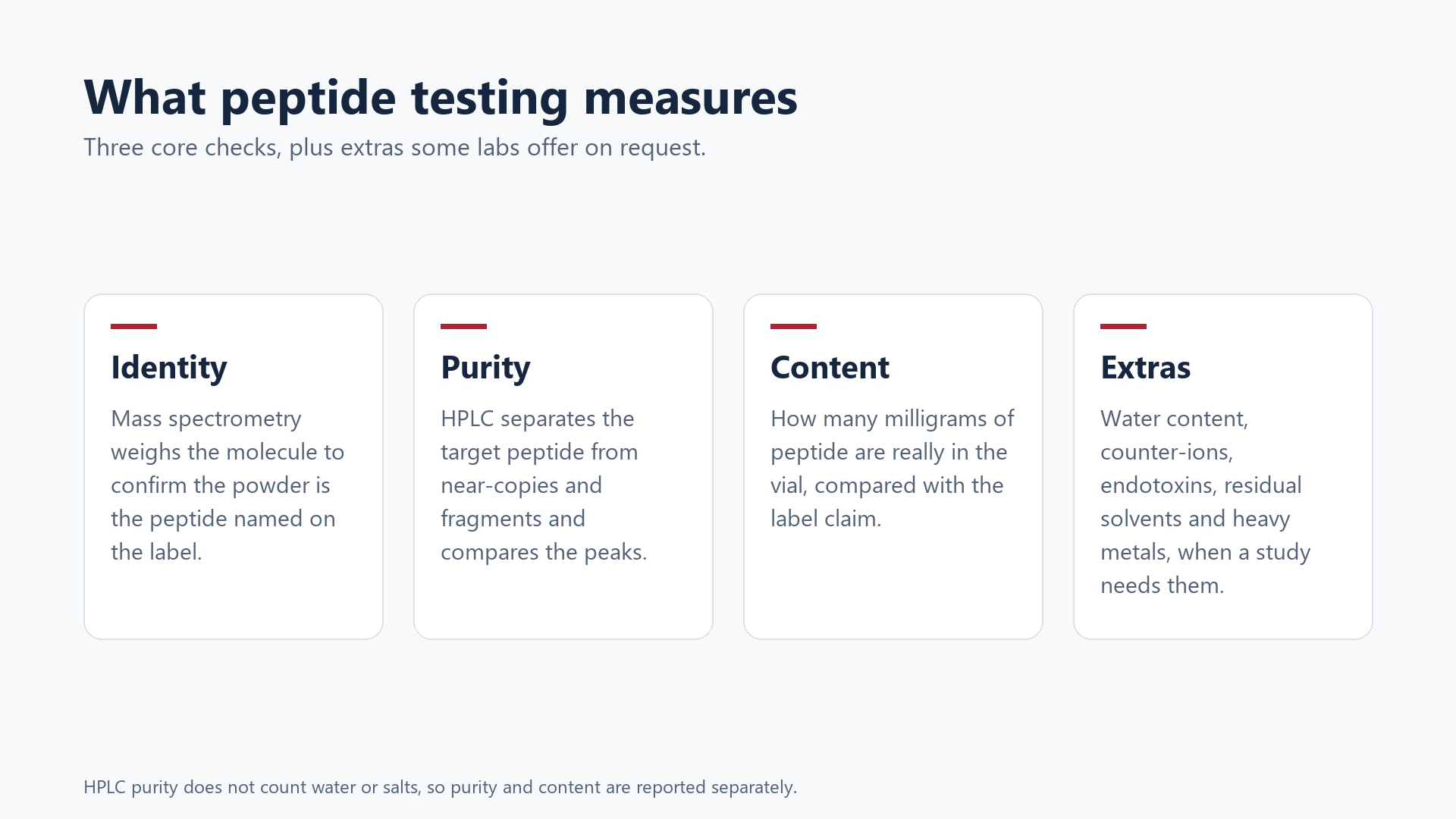
One point trips people up often. A purity figure from HPLC describes only the peptide-like material the column can see. It does not count water or salts. So a sample can show high purity and still contain a fair amount of non-peptide weight. That is why content and purity are reported as separate numbers.
How a peptide testing lab handles a sample
The process inside a good lab is more careful than most people expect. It starts the moment a sample arrives.
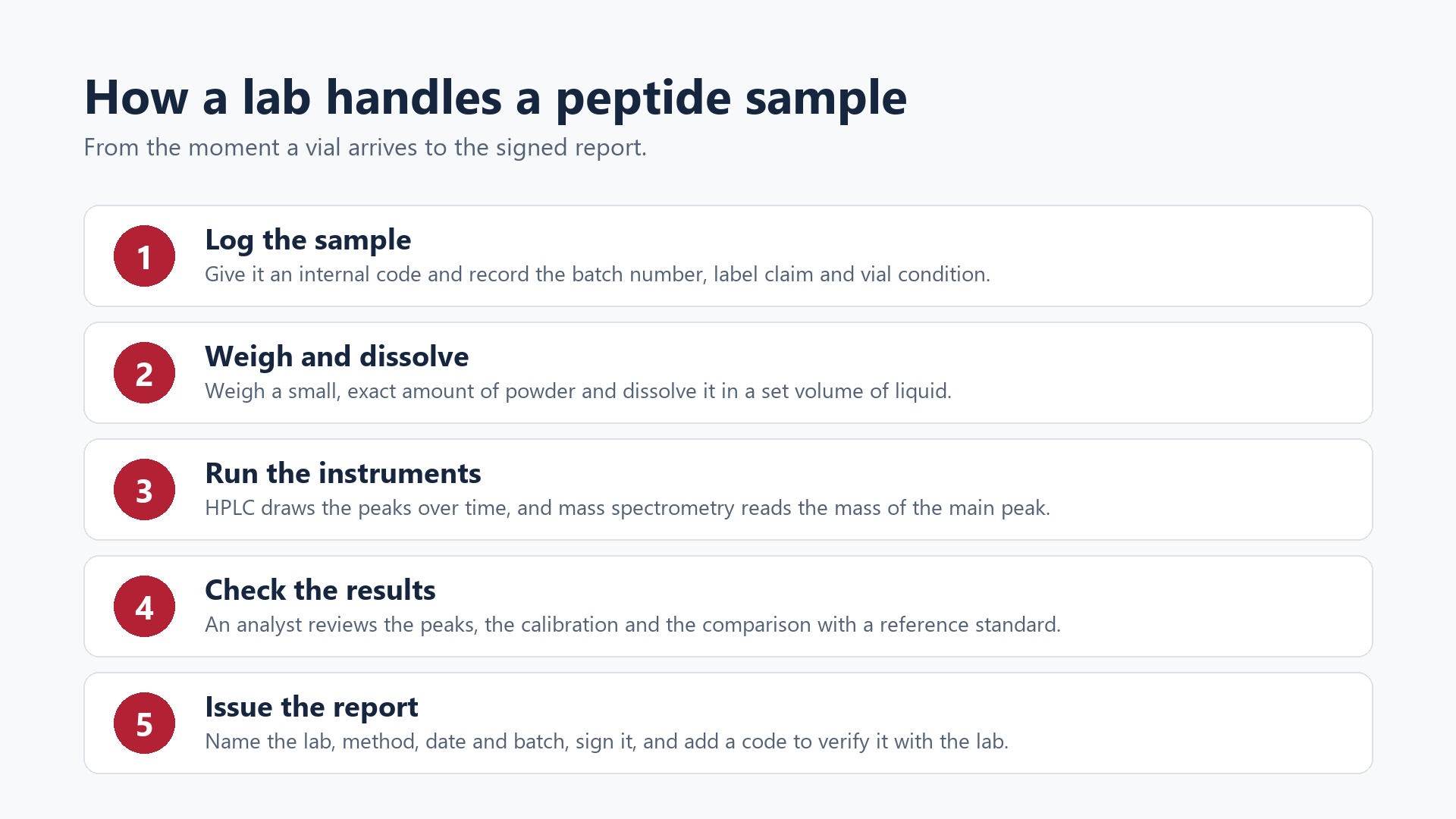
First, the sample is logged. It gets an internal code, and the lab records the batch number, the label claim and the condition of the vial. From here on, everything is tracked by that code, so results cannot get mixed up between clients. Many labs work “blind”, meaning the analyst sees only the code and the expected compound, not who sent it.
Next comes preparation. The analyst weighs out a small, exact amount of powder and dissolves it in a set volume of liquid. Precise weighing matters, because every later number depends on it. For content testing, the result is compared with a reference standard, a sample of the same peptide whose amount is already known.
Before the samples go in, many labs run a known test mix to show the instrument is separating peaks properly that day. This is often called a system suitability check, and a careful lab records it with every run.
Then the instruments run. HPLC separates the sample and produces a chromatogram, the graph of peaks over time. Mass spectrometry reads the mass of the main peak. The software works out the purity, and an analyst checks that the peaks look sensible and the machine was calibrated correctly that day.
Finally, the lab writes a report. A sound report names the lab, the method, the date, the batch tested and the results, along with a signature from whoever approved it. Many labs now add a verification code or QR code, so anyone holding the report can confirm with the lab that it is genuine and unchanged.
Accreditation is a useful extra signal. The international standard for testing labs is ISO/IEC 17025, which checks that a lab’s methods, staff and equipment are competent. In Canada, labs are accredited to it by the Standards Council of Canada. Not every capable lab in the research-peptide space holds it, but when a lab claims it, the certificate should be easy to check.
There is also a difference between who orders the test. A manufacturer’s own report is a starting point. A report from an independent lab, paid to test a sample with no stake in the result, carries more weight. That is what “third-party testing” means.
Choosing peptide testing labs and suppliers in Canada
In Canada, research-use-only peptides are not reviewed or authorized by Health Canada as medicines. That leaves testing as the main check on what is in a vial. For a lab, the useful question is not “was it tested?” but “how, by whom, and for which batch?”
When a supplier says its products are tested, a few follow-up questions sort strong claims from weak ones:
- Which lab did the testing, and is it independent of the seller?
- Which methods were used? Purity by HPLC alone does not confirm identity.
- Does the report’s batch number match the batch on your vial?
- Can the report be verified directly with the lab?
- How often is new stock tested, and is every batch covered?
Suppliers differ in how they share this. Some post reports on a public page. Others keep them on file and share them when asked. Canadian Peps, for example, is a Canadian shop that sells peptides for laboratory research only, and its about page says every batch is tested before it is listed. Whatever the approach, it is reasonable for a lab to ask for the report tied to its own batch and to keep a copy with its records.
Some research groups go a step further and send a sealed vial to an independent lab themselves. This costs money, but it gives the lab its own result for the exact material it will use. It is also the best way to settle any doubt about a report. If you do this, send the vial unopened, record the batch number and keep the lab’s report with your lab notebook.
Keep the limits of testing in mind. A report describes one sample, from one batch, on one day. It does not cover later batches, and it cannot show what happened to a vial after it left the warehouse. Two good labs may also report slightly different purity figures for the same batch, since methods and settings vary a little. A small difference is normal. A large one is worth a question.
Peptide testing will never be exciting, but it is the step that turns a white powder into a known research material. Knowing what the tests measure, how a lab handles a sample and which questions to ask makes it much easier to judge any report you are handed.
Research peptides are sold for laboratory research only and are not intended for human or veterinary use.
About the author: The Canadian Peps team runs a Canadian supplier of research peptides and lab supplies, sold for laboratory research only.






