Dental Health Innovations 2026: How AI, Robotics, and Smart Materials Are Redefining the Patient Chair
Introduction: The Dental Chair Has Never Been Smarter or More Consequential
Picture this: a patient walks into a dental office, settles into the chair, and walks out 15 minutes later with a brand new crown. No temporary restoration. No second appointment weeks later. An AI-driven robotic arm has just completed a procedure that once required two hour-long visits. This is not science fiction. This is dentistry in 2026.
Dental health innovations in 2026 are transforming every aspect of the patient experience, from the moment someone schedules an appointment to the long-term durability of their restorations. This article speaks to patients curious about what is now possible in the dental chair and to dental professionals evaluating which innovations merit adoption.
The timing could not be more significant. The global dental market is projected to grow from $44.71 billion in 2026 to $118.36 billion by 2034, exhibiting a compound annual growth rate of 12.94%. Dentistry is entering a period of historic expansion, and the technologies driving this growth are not isolated gadgets. They are converging to redefine patient outcomes, systemic health connections, and the very definition of what a dental visit can accomplish.
This article examines three major pillars shaping this transformation: AI and diagnostics, robotics and precision procedures, and smart materials alongside the oral-systemic health connection.
The State of Dentistry in 2026: A Market at a Crossroads
The dental services market is expected to reach $471.47 billion in 2026, up from $440.81 billion in 2025. This growth reflects elevated utilization after years of deferred care during the pandemic era. North America maintains a dominant position, contributing approximately $17.55 billion in 2026, up from $16.08 billion in 2025.
Yet a paradox defines this moment. Despite unprecedented technological advancement, untreated cavities still affect one in four adults, according to the CDC. Approximately 90% of dental practices report struggling with hiring staff, even with a growing pipeline of dental hygienist graduates. The top challenges dentists face in 2026 include insurance reimbursement issues, staffing shortages, and rising overhead costs.
This tension between innovation and operational reality shapes how practices approach technology adoption. Rather than cataloging tools in isolation, this piece examines how innovations translate to real clinical outcomes and systemic health benefits.
AI in the Dental Office: From Diagnostic Aid to Virtual Coworker
The significant new trend in 2026 is the adoption of AI agents that function as virtual coworkers, autonomously planning and executing multistep clinical workflows. These systems can analyze radiographic images, detect cavities, identify periodontal disease markers, assess bone loss, and flag pathology with high diagnostic accuracy.
The administrative revolution is equally transformative. AI-driven tools now handle scheduling, patient communications, and call center functions. In many cases, these systems replace traditional call centers at lower cost and with more consistent performance, freeing staff to focus on patient care.
Consider this: dental radiographic examinations in the U.S. generate approximately 320 million images annually. Many of these images capture systemic disease markers that traditional workflows never translate into actionable referrals. AI is beginning to unlock this largely untapped diagnostic resource.
AI Diagnostics and the Oral-Systemic Health Bridge
FDA-cleared dental AI systems can now detect carotid artery calcifications in routine dental X-rays. These calcifications serve as stroke risk markers, transforming a standard dental visit into an opportunity for cardiovascular screening.
The access point statistics are compelling: 27 million Americans see a dentist but not a physician each year. This makes the dental office a frontline opportunity for broader health screenings, including A1C monitoring for diabetes and blood pressure checks.
The clinical evidence supporting this approach is robust. Periodontal disease increases cardiovascular risk by 28% through systemic inflammation, with IL-6, TNF-α, and C-reactive protein as key inflammatory markers. By automatically flagging systemic markers in dental images and generating referral prompts, AI transforms routine dental visits into whole-health screening opportunities.
A February 2026 paper in the British Dental Journal called for stronger collaboration between medical and dental professionals to address the global burden of preventable oral diseases. California’s regulatory leadership reflects this shift: the California Dental Board announced in January 2026 that starting with the 2027 renewal cycle, all dentists must complete at least two hours of oral-systemic health education every two years.
Salivary Biomarkers: The Mouth as a Window to Whole-Body Health
Saliva contains biomarkers that can signal systemic conditions including diabetes, cardiovascular disease, and certain cancers. Point-of-care salivary testing is emerging as a powerful diagnostic tool.
Research published in Scientific Reports highlights that oral-systemic connections are laying the groundwork for novel diagnostic assays based on salivary biomarkers and microbiome-based signatures. For patients, this translates to non-invasive, chairside tests performed during routine cleanings: no needles, no lab visits, and results in minutes.
According to CareQuest Innovation Partners, prevention and longevity strategies in 2026 are expected to more consistently include oral health as a practical, scalable component of whole-person care.
Robotics in Dentistry: The Historic Milestone of Autonomous Procedures
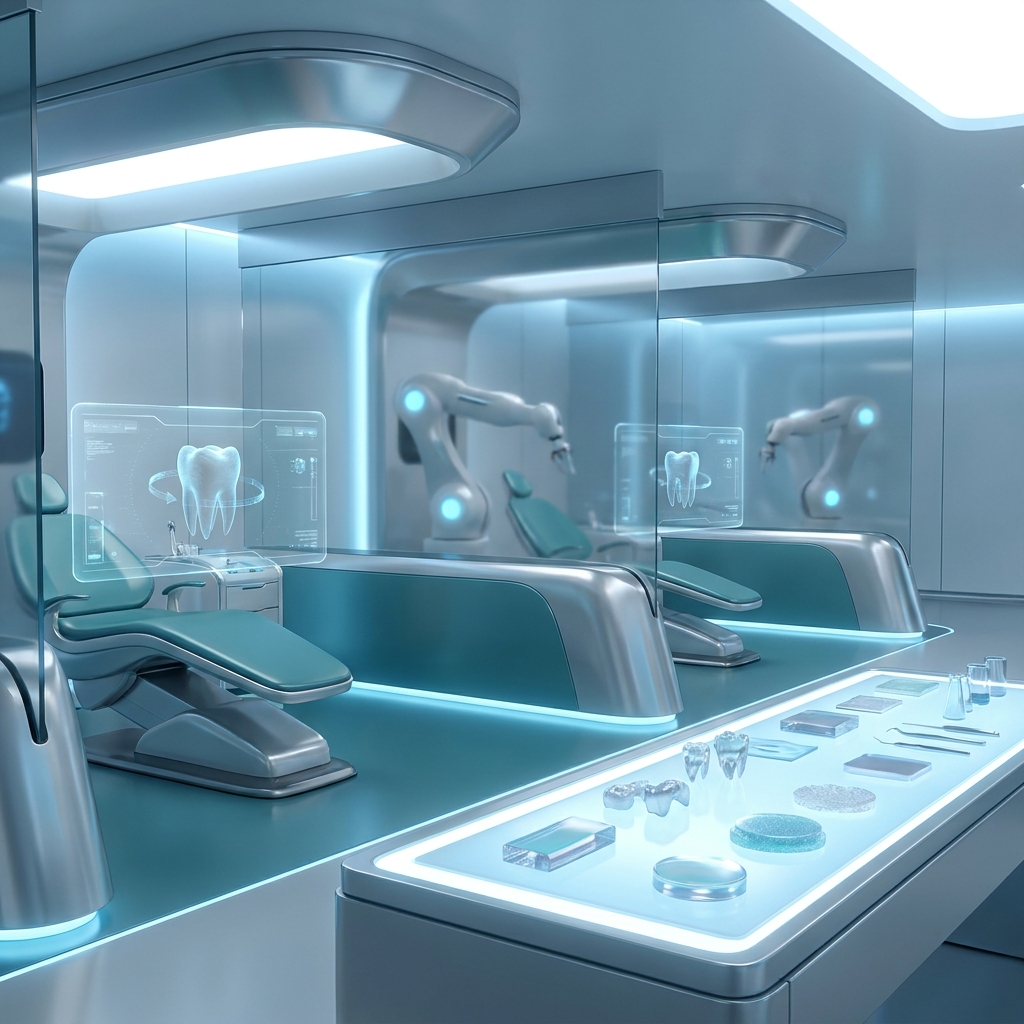
A company called Perceptive developed an AI-driven robotic arm that placed a dental crown in just 15 minutes, a procedure that normally requires two hour-long visits. The achievement represents a paradigm shift in restorative dentistry, yet it remains largely absent from mainstream dental editorial coverage.
It is important to distinguish between robotic guidance systems already in widespread use and fully autonomous robotics. Robotic guidance systems for implant placement report deviations of less than one millimeter and reduce surgery time by 15 to 20 percent in early clinical trials.
For patients, the benefits are tangible: reduced chair time, greater precision, less post-operative discomfort, and fewer return visits. For the profession, this raises important questions about the dentist’s evolving role, liability frameworks, and patient trust.
Robotic Implant Surgery: Precision That Changes Outcomes
Modern dental implant techniques already achieve success rates exceeding 95% over 10-year periods. Digital planning and guided surgery are reducing surgical complications further.
Robots equipped with advanced algorithms and sensors can perform intricate placement tasks with unparalleled accuracy, ensuring optimal implant positioning and minimizing error margins. The patient journey now flows seamlessly from digital planning and CBCT imaging to intraoral scanner impressions and guided surgical execution.
Intraoral scanners have become the standard in 2026, replacing traditional impressions and enabling precise digital models that reduce errors and remakes.
Smart Materials and Biomimetic Dentistry: Restorations That Think
A new generation of restorative materials has arrived, designed to mimic not just the appearance of natural teeth but their structure, composition, and behavior.
An April 2026 study published in MDPI Biomimetics highlights that biomimetics in dental restorative materials has shifted from copying tooth appearance to understanding how enamel and dentin function under real conditions, respond to stress, and change over time.
Three categories of smart materials are reshaping restorative dentistry:
- Self-healing composites that repair micro-cracks before they become fractures
- Antibacterial materials that actively resist secondary decay
- Smart pH-responsive materials that release protective agents in acidic environments
These materials reduce the cycle of restoration replacement, lower long-term treatment costs, and decrease the burden of repeat procedures. AMN Healthcare’s 2026 trend report identifies biomimetic and smart materials as a top innovation reshaping restorative dentistry.
3D Printing and Digital Workflows: Same-Day Dentistry Becomes the Norm
By 2024, the number of 3D printers in U.S. dental clinics surpassed the number of mills, with adoption now expanding globally. The global dental 3D printing market is projected to surpass $9.5 billion by 2032.
For patients, same-day dentistry means crowns, aligners, surgical guides, and dentures fabricated chairside or in-office. The weeks of waiting and temporary restorations are eliminated. The end-to-end digital workflow moves from intraoral scan to digital design to 3D print or mill to same-day delivery.
The dentures market is projected to climb from $1.67 billion in 2025 to $1.82 billion in 2026, driven by an aging population. 3D-printed dentures are making this process faster and more precise.
The cosmetic dentistry market is expected to surpass $5.6 billion by 2026, with veneers, whitening, and Invisalign demand driving growth. Digital workflows are accelerating delivery of aesthetic outcomes across the board.
Precision Dentistry and Genetic Testing: Personalizing Oral Care
Precision dentistry uses a patient’s genetic profile, microbiome data, and individual risk factors to customize prevention and treatment rather than applying one-size-fits-all protocols.
Practical applications include genetic risk scoring for periodontal susceptibility, personalized recall intervals, targeted nutritional guidance, and early oral cancer screening for high-risk genotypes.
Teledentistry and Laser Dentistry: Expanding Access and Comfort
Teledentistry is projected to account for 30% of all dental consultations by 2026, according to the American Telemedicine Association. This represents a dramatic shift in how patients first access dental care.
Teledentistry reaches underserved populations, rural communities, and patients with mobility limitations. The patient journey includes virtual triage, remote monitoring of orthodontic progress, post-operative check-ins, and asynchronous image review by dentists.
The Patient Perspective: What to Expect When Visiting a Cutting-Edge Dental Practice in 2026
A visit to a technology-forward practice in 2026 begins with AI-powered scheduling and digital intake. Patients undergo intraoral scanning rather than uncomfortable impression trays. AI-assisted diagnosis flags findings that might otherwise be missed, and same-day 3D-printed restorations eliminate the need for temporary crowns.
From the patient’s perspective, the technology translates to less discomfort, shorter appointments, more information, and greater confidence in diagnoses.
Common patient concerns deserve direct answers. AI does not replace the dentist; it serves as a diagnostic aid that the dentist interprets and acts upon. Robotic surgery has demonstrated safety in clinical trials with high precision. Insurance coverage for innovations varies, so patients should inquire directly with their providers.
A visit to a technology-forward dental practice in 2026 may also screen for cardiovascular risk, diabetes markers, and other systemic conditions. The dental chair has become a gateway to whole-body health.
Patients can empower themselves by asking: Does this practice use AI diagnostics? Does it offer same-day restorations? Can a dental visit include systemic health screening?
Conclusion: Dentistry’s Defining Moment and What It Means for Patient Health
The year 2026 represents a genuine inflection point in dental health innovation. AI, robotics, smart materials, and precision diagnostics are not future concepts but present-day clinical realities. The innovations covered in this article do not just improve smiles; they are creating new pathways to detect and prevent cardiovascular disease, diabetes, and other systemic conditions.
Despite remarkable progress, one in four adults still has untreated cavities. Access gaps persist. The workforce crisis remains unresolved. Innovation must be paired with equity and accessibility.
As the global dental market approaches $118 billion by 2034, the practices and professionals who embrace dental health innovations in 2026 will define the standard of care for the next generation of patients.
The mouth has always been connected to the body. Now, dentistry finally has the tools to prove it.
Discover the Dental Innovators Shaping the Future of Patient Health
Top Doctor Magazine profiles leading dental professionals who are deploying these innovations in their practices, helping patients find forward-thinking providers in their communities.
Dental professionals are invited to nominate a colleague or be nominated by a patient or Top Doctor Magazine representative for Top Doctor Magazine’s awards program, which recognizes practitioners driving meaningful change in oral health and patient outcomes.
Subscribe to Top Doctor Magazine’s free biweekly newsletter to stay current on dental health innovations, emerging medical technologies, and wellness breakthroughs.
Top Doctor Magazine connects patients with the doctors and innovations that are redefining what healthcare can accomplish, starting with the chair patients sit in twice a year.