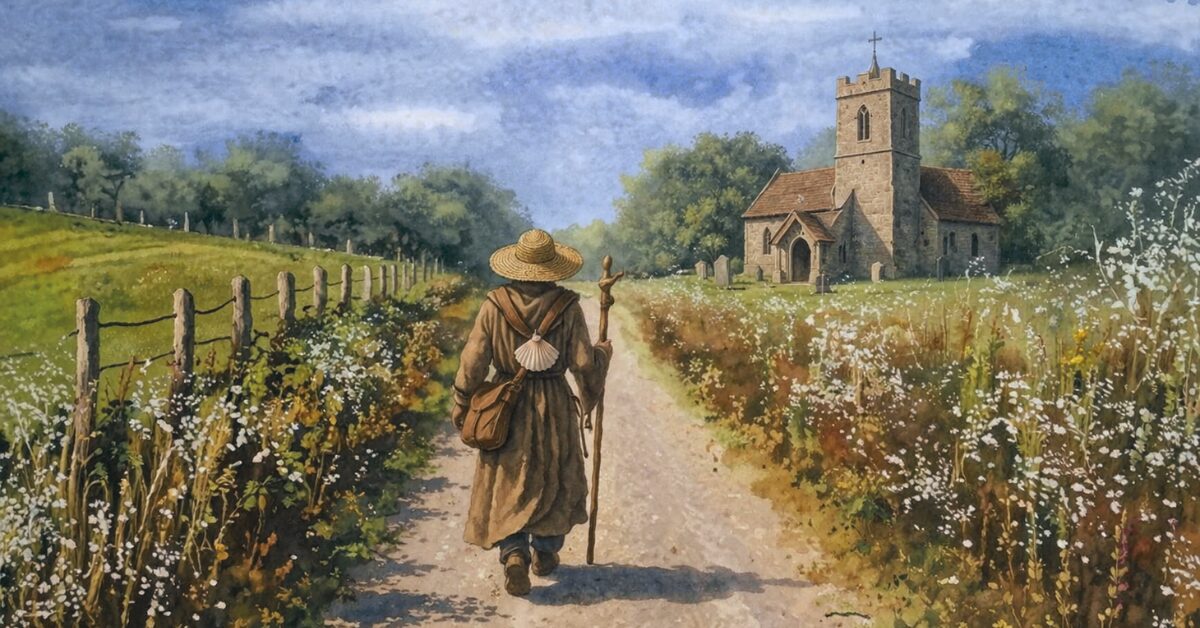
To the one who is anxious, depressed, fair-fallen, stuck, creatively stumped or broken, one may think of the ascetic prayer labyrinths ambulated once by countless ascetic folk who, in the shadows of their cathedrals, those forests of light in stone, reaching up toward the divine, walked to free their minds for prayer, or to free their minds for the benefit of imagination, to free the still body from its tendency to chain down the mind with rumination. Long before walking became quantified by watches, apps, and step goals, it already occupied an older place in human life: a bodily act with an inward consequence.
The old Latin phrase remains fitting: solvitur ambulando or “it is solved by walking.”
While often attributed to Augustine of Hippo, the phrase apparently does not come directly from the saint himself. Yet, it is deeply compatible with the Augustinian understanding that movement often aids clarity of soul and mind; the phrase later became famous in philosophical traditions through its practical demonstration: if a problem exists, one may often resolve it literally by moving through it. Walking, in its own modest way, allows the body to do something simple enough that the mind may begin to breathe again.
We are not necessarily talking about ordinary modern movement, nor what might be called the daily office of modern man’s small-walking: from the remote to the fridge, from the couch to the bed, from the car to the grocery store, or the short to-and-fro that fills our lives without ever truly becoming real movement. Nor are we merely speaking of what some modern fitness circles call incidental steps or what might pass for “NEET” activity — useful enough in itself, but not quite the thing intended here.
We are speaking of intentional walking for an extended period of time.
We are speaking of at least something with moderate intensity, around three to four miles per hour, long enough that the body and mind begin to settle into a rhythm. Long enough that thought ceases to arrive in fragments, but begins to flow instead.
There is, of course, the bodily fitness aspect. Myriad studies have shown how intentional walking as exercise decreases all-cause mortality. Though running burns more calories over the same period of time, walking uses a greater percentage of fat as fuel. It is easier on joints. Hunger hormones are less aggressively triggered. It preserves lifting recovery. Cortisol generally remains lower than with more strenuous exercise. It is sustainable, especially when paired with strength training or weight lifting for those interested in body recomposition.
That sustainability matters more than many realize.
What you enjoy, you repeat. What you repeat changes the body.
In so many practitioners’ experience, walking belongs to that category of exercise that succeeds because it is truly livable. 10,000 steps in a day remains a worthy benchmark, but more is often better, around the 12,000 to 15,000 mark if the time and the will for it exist. Provided nutrition is reasonably dialed in, extended walking, especially when paired with resistance training, can make one remarkably efficient at fat burning over time without producing the nervous-system fatigue that causes so many other fitness efforts to collapse.
Yet walking’s deeper power may lie beside the bodily fitness aspect alone.
Next to physical health, it has been proven repeatedly to lower stress, anxiety, and depression. It fosters creativity and problem-solving in much the same way ideas often arrive in the shower or while driving: one part of the brain is occupied while the rest is free to wander.
That wandering is not aimlessness, though. Walking gives the brain room for the childlike imagination to reemerge. It opens mental space. Rhythmic repetition frees thought, and ideas often appear while walking that refuse to appear at a desk. It favors long-form thinking, and that may be one reason why creative people throughout history have loved it, returned to it, and almost relied upon it.
Steve Jobs openly valued regimented long walks and directly credited them as part of the environment in which some of his clearest innovations emerged. One cannot help wondering what might have been lost to modern life had he never taken them.
Charles Dickens, that great man of nineteenth-century English literature, often walked for hours through London in the early morning after insomnia refused him sleep. He is said to have done this for miles at a time, and it is difficult not to suspect that many of the scenes and figures that populate A Christmas Carol, for example, first came into shape beneath the foggy gaslit city as it woke up to meet the day.
Ludwig van Beethoven cherished his long walks in the woods. One wonders what he saw there, from creation itself, that inspired those sonic bolts of lightning that still strike listeners centuries later.
Immanuel Kant became so exact in his walking that neighbors reportedly adjusted their clocks by him.
Thomas Jefferson once remarked that his fondest form of exercise was walking his property with a gun, shooting when he pleased.
Likewise, according to his autobiography, Benjamin Franklin spent hours each morning on intentional, extended walks, though swimming, as it is said, took the prize as this founding father and inventor’s most beloved exercise.
Famously, it was on many walks through the Oxfordshire countryside that J. R. R. Tolkien, in conversation with C. S. Lewis, helped move Lewis toward Christianity — a conversion that would eventually yield one of history’s greatest Christian apologists and Anglican theologians.
Those indomitable Romantic poets William Wordsworth and Samuel Taylor Coleridge walked the Lake District for hours on end like the true artists that they were: they focused on the present moment, considered their beautiful surroundings, observed, noticed, filtered, and re-presented and repackaged the material around them into some of the greatest poetry in the English language. Their movement was not separate from their art. Instead, it was part of the condition that allowed art to appear. This lends credence to the quote by the great record producer Rick Rubin that, “The object isn’t to make art, it’s to be in that wonderful state which makes art inevitable.”
The list goes on and on.
Modern research has simply confirmed what so many of these figures already practiced by instinct. A 2014 study from Stanford University found that walking significantly improved creative thinking compared with sitting still, and notably, the walks did not need to be long. Even five to 16 minutes produced measurable gains in creative output, with the mind often remaining primed after the walk had ended. Outdoor walking offered additional benefits, though indoor walking still proved effective. The important fact was movement itself.
Modern life, with its endless assaults upon the attention span and its ever-increasing electronic baubles, fragments thought into restless pieces. Walking does the opposite.
It is exercise, yes, but also something deeper than exercise — perhaps even something spiritual. We can look at it as almost a form of ordered wandering.
That phrase, solvitur ambulando, matters because walking does something subtle: it gives the body a simple task so the mind may stop colliding with itself, and thoughts cease arriving as interruptions. This is also why so many have paired extended walking with meditative prayer, with great benefit to their mental health and spiritual life.
“Healthy mind, healthy body” is not merely modern advice. It is one of the oldest recognitions available to ordinary human experience. It burns calories, yes. Generally uses fat for fuel as a greater percentage, sure. It lowers stress. It aids body recomposition. It improves cardiovascular health. But perhaps its deepest gift is that it still gives troubled or blocked minds what the old thinkers who roamed cathedrals, woods, and long roads all knew it could: room enough for thought to flow freely again.
References:
- https://youtu.be/iz7Dl-FNBiY?si=cJZT4ytQOE7I7el6
- https://news.stanford.edu/stories/2014/04/walking-vs-sitting-042414