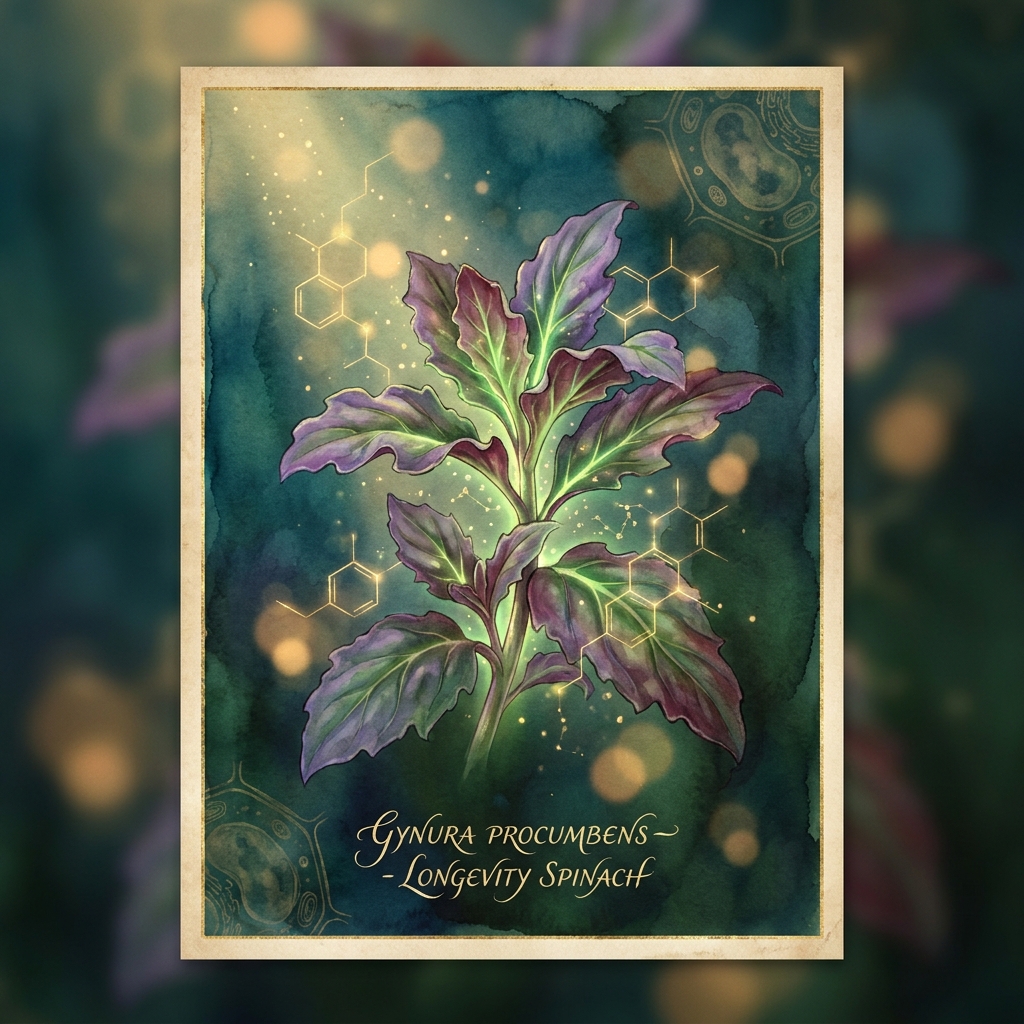
Longevity Spinach Gynura Procumbens: The Science Behind the Plant
Introduction: A Humble Leaf With a Remarkable Scientific Story
In Malay, it is called Sambung Nyawa, meaning “prolongation of life.” In Chinese, it is known as Bai Bing Cao, “the grass that heals 100 diseases.” These names are not marketing inventions. They reflect centuries of ethnomedicinal observation across Southeast Asia, China, and Africa, where this unassuming green leaf earned a reputation that modern laboratories are only now beginning to explain.
Gynura procumbens (Lour.) Merr. is a fast-growing perennial trailing vine in the Asteraceae family, native to Indonesia, Malaysia, Thailand, Vietnam, and the Philippines. With its fleshy purple-tinged stems and dark-green edible leaves, it is easy to dismiss as just another leafy vegetable. Yet most online content about this plant focuses on how to grow it or offers a quick listicle of benefits. The real story is more interesting: it lies in the plant’s specific bioactive compounds and the molecular pathways they engage, pathways directly relevant to aging, inflammation, and cellular repair.
This article maps that phytochemical profile to the molecular biology of longevity, connecting traditional plant wisdom to research published as recently as January 2026. The flavonoid profile of this plant places it within a broader category of plant-based longevity compounds, the same scientific philosophy that guides modern regenerative wellness formulations.
What Is Longevity Spinach? Botanical Identity and Traditional Roots
Gynura procumbens is an evergreen perennial climber, hardy in USDA zones 9 through 11 and native to tropical Southeast Asia and parts of Africa. Its fleshy, purple-tinged stems support dark-green, succulent-like leaves that can be eaten raw in salads or cooked into stir-fries and soups.
The ethnomedicinal heritage is rich. Traditional uses across Southeast Asia include blood sugar regulation, hypertension management, wound healing, fever reduction, and anti-inflammatory applications. Importantly, the plant is consumed as food. The traditional dietary approach involves eating roughly 30 to 50 grams of fresh leaves per day, situating it as a food-medicine bridge rather than a purely pharmaceutical entity.
The Phytochemical Architecture of Gynura Procumbens
To understand why this plant is scientifically interesting, one must examine its molecular inventory. A September 2025 MDPI Plants review and a January 2026 EmanResearch study provide the most current comprehensive picture of its chemistry. Both confirm that the leaves are particularly rich in flavonoids, the class of polyphenols most associated with longevity-relevant biological activity.
Flavonoids: The Longevity Compound Class
The key flavonoids in this plant include quercetin, kaempferol, myricetin, rutin, and astragalin. Each has documented roles in anti-inflammatory, antioxidant, and cellular signaling pathways.
Flavonoids matter for longevity science because they are among the most studied plant-derived compounds in aging biology. Quercetin and kaempferol appear repeatedly in research on cellular senescence, oxidative stress, and inflammatory signaling. This profile places the plant within a broad, well-researched category of plant-based compounds studied across diverse botanical traditions worldwide, including compounds investigated for their role in supporting the body’s natural repair systems.
Phenolic Acids and Other Bioactive Constituents
Beyond flavonoids, the plant’s phenolic acid profile includes chlorogenic acid, caffeic acid, ferulic acid, gallic acid, and protocatechuic acid. Chlorogenic acid stands out for its well-studied role in glucose metabolism regulation and its ability to modulate gut-derived inflammatory signals, a topic closely tied to understanding the gut microbiome and its influence on systemic health.
The plant also contains terpenoids (lupeol, β-amyrin) and phytosterols (stigmasterol, β-sitosterol), which contribute anti-inflammatory and membrane-stabilizing properties, along with saponins, tannins, and alkaloids. The synergistic interaction between these compound classes, rather than any single molecule, is what makes whole-plant extracts scientifically compelling.
Molecular Pathways: How Gynura Procumbens Works at the Cellular Level
Knowing which compounds are present is one thing; understanding what they do at the molecular level is where genuine scientific depth lies.
AMPK Activation: The Master Regulator of Cellular Energy and Longevity
AMPK (AMP-activated protein kinase) is the cell’s master energy sensor and a central regulator of metabolic homeostasis. It is often described as a longevity switch because its activation mimics the effects of caloric restriction and exercise.
Compounds in this plant, particularly quercetin and chlorogenic acid, activate the AMPK pathway. This triggers improved glucose uptake, reduced lipid synthesis, and enhanced mitochondrial biogenesis. AMPK activation also promotes GLUT4 translocation to cell surfaces, increasing glucose uptake in skeletal muscle. A December 2024 Biomedical and Pharmacology Journal study documented exactly this mechanism.
NF-κB Inhibition: Targeting the Molecular Root of Chronic Inflammation
NF-κB is the master transcription factor governing inflammatory gene expression. Its chronic activation is a hallmark of aging-related disease, often called “inflammaging.” A 2022 PMC study showed that the plant’s crude extract reduces NO, TNF-α, and PGE2 secretion by inhibiting NF-κB and AP-1 nuclear translocation via downregulation of PI3K/Akt and MAPK signaling.
A 2022 ScienceDirect study found the extract reduced monocyte adhesion to human endothelial cells and inhibited ICAM-1, VCAM-1, and MCP-1, molecules that drive vascular inflammation and are directly relevant to cardiovascular aging.
PI3K/Akt and MAPK Signaling: Cellular Survival and Stress Response
PI3K/Akt is a central signaling hub governing cell survival, proliferation, and metabolism, while MAPK pathways regulate stress responses. The same 2022 PMC study identified the downregulation of these pathways as the upstream mechanism by which the plant suppresses NF-κB and AP-1 activity. Activation of Akt in glucose metabolism also mimics insulin activity, explaining the plant’s antidiabetic effects in animal models.
The Antidiabetic Evidence: Preclinical Findings and What They Reveal
This body of research is less about a simple “lowers blood sugar” claim and more a window into how the plant’s compounds interact with metabolic machinery. An August 2025 Frontiers in Pharmacology review analyzed 4 in vitro and 12 in vivo studies, finding that extracts (50 to 3,000 mg) show antidiabetic potential, with some studies suggesting efficacy comparable to metformin.
The January 2026 EmanResearch study classified the plant as a “multi-target phytotherapeutic candidate” for Type 2 Diabetes. Critically, animal studies show it lowers blood sugar in diabetic animals but not in normal animals, suggesting a homeostatic mechanism rather than a pharmacological override. This distinction matters given that diabetes affects roughly 10.5% of adults worldwide, with over 84 million people in South Asia alone living with Type 2 diabetes.
Anti-Inflammatory and Cardiovascular Longevity Effects
Inflammation is one of the most direct pathways through which aging drives mortality. The 2022 monocyte adhesion study is directly relevant here, as ICAM-1, VCAM-1, and MCP-1 are early markers of atherosclerotic plaque formation. A 2021 PMC study on postmenopausal rats fed a high-fat diet found the ethanol extract improved vascular reactivity and suppressed inflammation via nitric oxide/cGMP pathways. Endothelial dysfunction is among the earliest detectable signs of biological aging, positioning these findings squarely within healthy aging research.
Hepatoprotective and Organ-Protective Properties
Liver and kidney health are critical determinants of healthspan. A February 2025 PLOS ONE study showed that a leaf-extract-loaded SMEDDS significantly reduced liver damage in cisplatin-induced injury models, achieving 4.8 times greater dispersibility than standard extract. An April 2024 Chemistry & Biodiversity study similarly demonstrated reduced oxidative stress and inflammatory mediators in organ tissue, with polyphenols confirmed via HPLC-DAD.
Quercetin and Kaempferol: Longevity Compounds in Broader Context
Quercetin has been studied as a senolytic compound capable of selectively clearing senescent cells, a hallmark of aging. Kaempferol has been investigated for supporting mitochondrial function and modulating pathways associated with cellular lifespan.
The same scientific philosophy that identifies these flavonoids as longevity-relevant guides plant-based regenerative wellness formulations. STEMREGEN®‘s approach, selecting botanicals based on documented effects on biological signaling rather than tradition alone, reflects this evidence-based ethnobotany. This is a conceptual parallel, not a claim that Gynura procumbens is an ingredient in STEMREGEN® products.
The Bioavailability Challenge: Why Delivery Matters as Much as the Compound
The plant’s bioactive compounds face real delivery challenges: poor water solubility, low gastrointestinal stability, and limited oral absorption. This is why nanoformulation research such as SMEDDS matters, as illustrated by the 4.8x dispersibility improvement noted above. The gap between in vitro activity and in vivo efficacy is often a bioavailability problem, meaning extraction method, standardization, and delivery format determine whether compounds reach their targets. STEMREGEN®’s emphasis on ethical and meticulous sourcing reflects this same understanding that quality and bioavailability matter as much as the compounds themselves.
Safety Profile and Practical Considerations
Current evidence is favorable. Acute toxicity studies show no mortality at doses up to 5 g/kg in rats, and a July 2025 IJRIAS subacute toxicity study across five dose groups found no significant abnormalities. Consuming 30 to 50 grams of fresh leaves daily is generally considered safe for healthy adults.
That said, individuals taking blood pressure or diabetes medications should consult a healthcare provider due to potential additive effects. One of the few human studies, an antiherpetic RCT, showed viral culture reduction from 48.7% to 7.69% in the treated group. Robust human clinical trials remain lacking, and standardized extract preparation is a cited limitation in the existing literature. In the United States, these products fall under the FDA’s DSHEA framework and cannot claim to treat or cure disease.
From Ethnobotany to Regenerative Science
Gynura procumbens is not simply a traditional remedy validated by science. It is a case study in how plant-derived compounds engage the molecular pathways that govern aging, inflammation, and cellular repair. The names Sambung Nyawa and Bai Bing Cao were not arbitrary; they reflected centuries of empirical observation of a plant that modulates AMPK, NF-κB, PI3K/Akt, and MAPK pathways simultaneously.
STEMREGEN®’s formulation approach reflects this same philosophy. Founder Christian Drapeau, MSc, has spent more than 30 years studying how plant-derived compounds support the body’s natural regenerative capacity. The product line (Release, Mobilize, Signal) is built on the principle that specific botanical compounds can support endogenous stem cell mobilization, microcirculation, and cellular signaling, sharing conceptual DNA with the multi-target phytotherapeutic approach this plant exemplifies. This work connects to a broader movement in regenerative medicine that is reshaping how we think about cellular health and longevity.
Conclusion: Ancient Wisdom, Modern Molecular Science
This article has moved from traditional names and ethnomedicinal roots through phytochemical architecture to the specific pathways (AMPK, NF-κB, PI3K/Akt, MAPK, and GLUT4) that translate bioactive compounds into documented biological effects. The plant’s value lies not in any single compound but in its multi-target engagement of pathways central to aging biology.
The preclinical data is compelling and growing, with significant publications in 2025 and 2026, but robust human clinical trials remain the critical next step. Understanding the science behind plants like Gynura procumbens is the first step toward making informed, evidence-based decisions about longevity and cellular health.
Explore the Science of Plant-Based Cellular Support
For readers interested in how plant-based compounds support the body’s innate repair systems, STEMREGEN® represents a natural next step. The company’s core concept, Endogenous Stem Cell Mobilization (ESCM), applies plant-based longevity science to support circulating stem cells, microcirculation, and cellular signaling.
Its three-product system (Release, Mobilize, and Signal) is grounded in more than 20 years of research by founder Christian Drapeau, MSc. Beyond products, the brand offers blog articles, science videos, podcasts, and the book Cracking the Stem Cell Code.
Discover how STEMREGEN®’s plant-based formulations support the body’s natural repair systems. Explore the science at stemregen.co.
Licensed healthcare professionals interested in the clinical application of ESCM science can also request a practitioner discovery call.