The Longevity Noodle: Ancient Tradition Meets Modern Science
Introduction: A Bowl That Carries a Thousand Years of Wishing
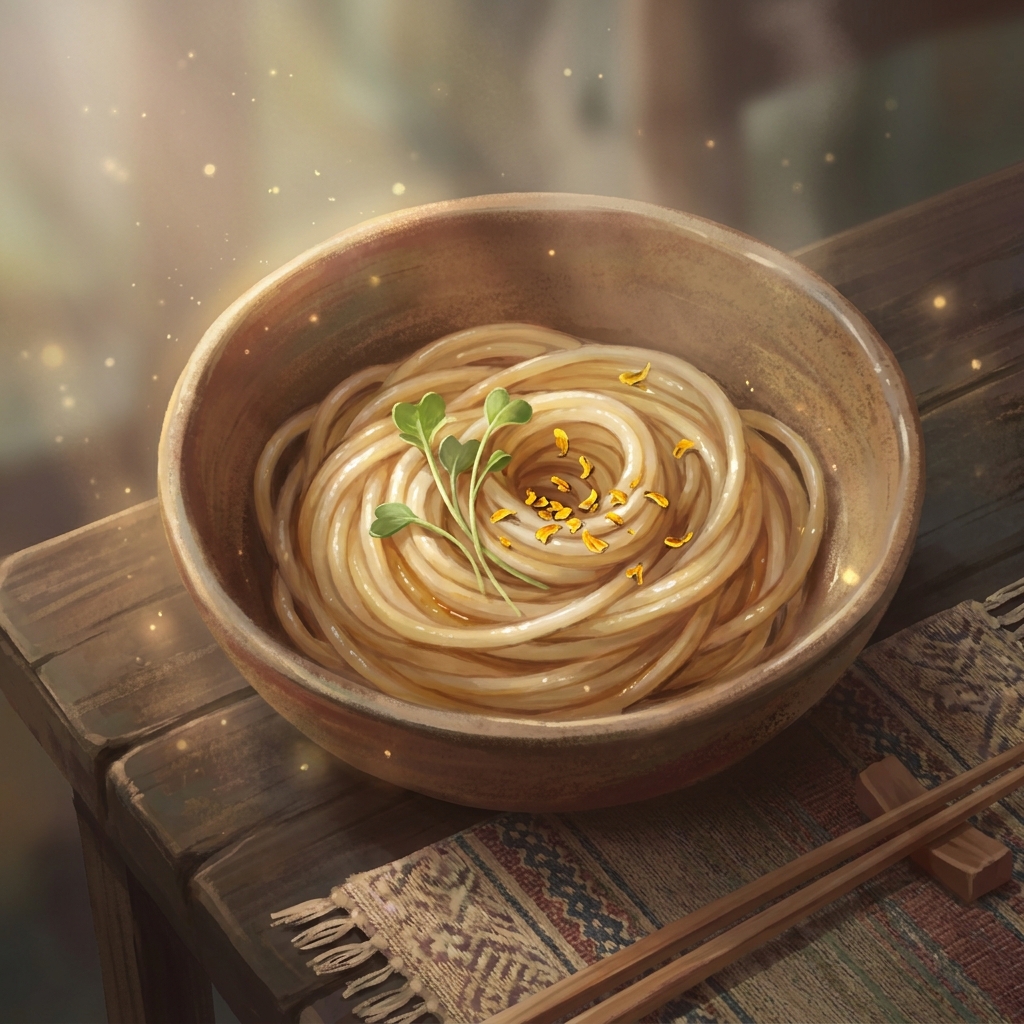
Picture a single, unbroken noodle strand coiled in a steaming bowl, glistening under the warm light of a family tradition table. Around it gather grandparents, parents, and children, assembled to mark a birthday or the second day of the Lunar New Year. No one bites into the noodle carelessly. There is an intention in the air, a shared hope passed silently from one generation to the next.
This is the longevity noodle, known in Mandarin as chángshòu miàn (长寿面), literally “long life noodles.” Its very form is its message: length symbolizes a long life, and continuity symbolizes a life uninterrupted.
This article delivers both the full cultural depth of this tradition and a bridge to what modern science now understands about diet, cellular repair, and healthy aging. The longevity noodle is not merely a recipe or a festive footnote. It is one of the world’s most enduring edible symbols, with documented roots stretching back at least a thousand years and a living presence in kitchens from Guangdong to Toronto to São Paulo. Ancient cultures encoded longevity wisdom in ritual and symbol; modern science encodes it in data and biology. As it turns out, the two are far more aligned than most people realize.
What Is a Longevity Noodle? Defining the Tradition
A longevity noodle is a wheat or egg-based noodle stretched or cut into exceptionally long, unbroken strands, served whole in a bowl, often as a single strand coiled to fill the vessel.
The cardinal rule is simple but sacred: each strand must be eaten whole, never bitten, cut, or broken. Breaking the noodle is believed to symbolically shorten one’s lifespan, transforming the act of eating into a ritual of intention.
The most common variety is Yi Mein (伊面), also called e-fu noodles. This Cantonese egg-wheat noodle is made with sodium bicarbonate and deep-fried before drying, giving it a distinctive golden color and a spongy, chewy texture that absorbs sauce exceptionally well. Authentic tradition calls for a single, unbroken strand per bowl, a detail many modern recipes quietly abandon for convenience. Typically, the dish is accompanied by a poached or fried egg, symbolizing perfection and completeness.
The Origin Story: Emperor Wu, Homophones, and the Problem with Legends
The most popular origin story traces the tradition to Emperor Wu of the Han Dynasty (141 to 87 BCE), who reportedly associated long faces with long life. Because the Chinese words for “face” and “noodle” (miàn) are homophones, eating long noodles became a linguistic and symbolic proxy for wishing longevity. The story is elegant, tying the tradition to one of China’s most powerful dynasties and grounding it in the poetic logic of the Chinese language itself.
Yet modern food historians largely dismiss the Emperor Wu legend as folklore, noting it lacks documentary evidence from the Han period. The stronger historical record points to the Song Dynasty (960 to 1279 CE), where written references appear in scholar Ma Yongqing’s prose collection Lanzhenzi, establishing at least a 1,000-year documented history. Tang Dynasty poet Liu Yuxi (618 to 907 CE) referenced noodles in the context of birthday celebrations, suggesting the symbolic association predates even the Song record, as reported by CNN Travel and CBC Life.
The contested origin is itself instructive. Traditions do not require a single verifiable founding moment to carry meaning. The longevity noodle’s power comes from centuries of lived practice.
When the Noodle Appears: The Full Spectrum of Auspicious Occasions
Contrary to common belief, longevity noodles are not primarily a Lunar New Year dish. They are served across life’s most significant moments: birthdays (especially for elders), Lunar New Year (particularly the second day), weddings, new baby celebrations, promotions, and business milestones.
In northern China, a lesser-known custom calls for noodles on the 7th, 17th, and 27th days of the Lunar month, representing auspicious days for children, adults, and the elderly respectively. The tradition’s vitality is measurable: demand at Hong Kong’s Aberdeen Yau Kee Noodles Factory increases by 20 to 30 percent during the Spring Festival. The unifying logic is clear: the longevity noodle appears whenever a community wishes to mark a transition, celebrate a life, or invoke good fortune.
Decoding the Bowl: The Symbolism of Every Ingredient
A bowl of longevity noodles can be read as a symbolic text, with each ingredient carrying meaning most diners never consciously register.
- The noodle: length equals lifespan; unbroken continuity equals an uninterrupted life.
- The egg: perfection, completeness, and the full circle of life.
- Shiitake mushrooms: prosperity and “success in all undertakings” (东成西就).
- Bok choy and leafy greens: purity, vitality, and new beginnings; in some dialects, the word for greens is a near-homophone for “fortune.”
- Carrots: luck and good fortune.
A bowl of longevity noodles is therefore an edible wish list, a structured expression of what a community hopes for the person being celebrated.
A Tradition Across Borders: Regional Variations and Cross-Cultural Parallels
The longevity noodle is not monolithic. Northern China favors thick, hand-pulled wheat noodles in rich meat broth, suited to the colder climate. Southern China, particularly Guangdong and Fujian, prefers thinner egg noodles in clear, delicate broth. Fujian and Taiwan use misua (fine wheat vermicelli, mǐ xian), sometimes paired with abalone. Fujian Province has even designated its “long-haired noodles,” extremely fine handmade noodles traced to the Song Dynasty, as intangible cultural heritage.
Southeast Asian diaspora communities blend local flavors such as chili or coconut milk while preserving the uncut tradition. Cross-cultural parallels abound: Korean janchi guksu is served at birthdays and weddings with an explicit longevity wish, and Japanese toshikoshi soba are eaten on New Year’s Eve for luck. Both echo the same “length equals longevity” logic, suggesting a pan-Asian intuition documented across the region. Today, many second-generation immigrant families serve both a birthday cake and a bowl of longevity noodles, a living example of cultural synthesis.
The Tradition Under Pressure: Commercialization, Dilution, and the Scissors Problem
The tradition faces a modern challenge: commercialization that preserves the aesthetic while stripping away the meaning. Some pre-packaged “longevity noodles” are sold with scissors for portion control, a direct contradiction of the ritual’s most fundamental rule. Restaurant large-batch cooking often produces soggy, flavorless noodles that prioritize throughput over ritual integrity.
Social media plays a double-edged role. Instagram and TikTok have popularized rainbow-colored, spiral-plated versions that introduce the tradition to new audiences but sometimes reduce it to an aesthetic divorced from meaning. When the form survives but the meaning is lost, culture becomes costume. Still, the tradition has endured a thousand years of upheaval and migration, suggesting it carries something genuinely irreplaceable.
From Symbol to Science: What Researchers Now Know About Diet and Longevity
For millennia, cultures have used food as a vehicle for longevity wishes. Modern science is now asking whether those intuitions had biological grounding. A 2025 bibliometric analysis published in Nutrients covering 2,203 diet-and-longevity studies found research peaked in 2021 and continues to grow, with China ranking second globally in study volume. The culture that gave the world the longevity noodle is also a leading producer of longevity science.
While a February 2026 npj Aging article notes that precise dietary recommendations for extreme lifespan remain elusive, the evidence consistently points toward plant-rich, anti-inflammatory dietary patterns. Notably, the longevity noodle’s traditional ingredients align with this science: shiitake mushrooms contain beta-glucans and antioxidants, garlic and ginger are among the most studied anti-inflammatory ingredients, and leafy greens provide folate and phytonutrients linked to reduced oxidative stress. Blue Zone and Mediterranean research draws similar conclusions, and a 2026 PMC review highlights bioactive compounds in functional foods as an active anti-aging frontier. As a 2025 Biogerontology article notes, this is not ancient wisdom being “proven right” simplistically, but two knowledge systems converging through different methods.
The Biology of Longevity: Cellular Repair and the Body’s Innate Renewal System
Healthy aging is not just about what people eat. It is about how effectively the body repairs and renews itself at the cellular level. This is where the concept of endogenous stem cell mobilization (ESCM) enters. The body’s own stem cells, released from bone marrow, circulate through the bloodstream and migrate to tissues needing repair. This natural mechanism declines with age, diminishing the body’s capacity for recovery and renewal.
The same anti-inflammatory dietary patterns associated with longevity also support the cellular environment in which stem cell mobilization occurs, reducing the signal noise of excess cytokines and chronic inflammation that impairs repair. This is an area of active investigation, with researchers exploring how diet, exercise, and targeted nutritional support influence the body’s endogenous repair capacity. Those interested in the foundational science can explore more through resources on stem cell biology.
STEMREGEN® and the Science of Endogenous Stem Cell Mobilization
STEMREGEN® is a science-backed, plant-based supplement company built on the research of founder and Chief Science Officer Christian Drapeau, MSc, a neurophysiologist with more than 30 years in medical research and more than 20 years dedicated specifically to stem cell biology.
The product line follows a three-mechanism approach:
- Release supports stem cell release from bone marrow.
- Mobilize supports microcirculation and stem cell delivery to tissues.
- Signal reduces excess cytokines to improve the cellular environment for repair.
The flagship Release product features clinically tested, trademarked ingredients with documented increases in circulating stem cells: StemAloe® (+80%), sourced from Madagascar; SeaStem™ (+35%), from the Tibetan Plateau; and StemAFA™ (+25%), from Klamath Lake, Oregon. Every formula is 100% plant-based, consistent with the dietary patterns linked to longevity in the literature above. Release SPORT (NSF Certified for Sport and WADA compliant) serves athletic recovery, while the Daily Repair Protocol bundles all three mechanisms. STEMREGEN® positions itself not as a replacement for healthy diet, but as targeted support for the body’s innate repair mechanisms: the biological layer beneath the cultural wisdom of the longevity noodle. Readers can explore further through Drapeau’s book, Cracking the Stem Cell Code.
Buying and Preparing Longevity Noodles: A Practical Guide
For those ready to bring the tradition home, the following guidance applies.
On the packaging: seek uncut, full-length strands. Choose Yi Mein (e-fu noodles) for the classic Cantonese style, misua (mǐ xian) for the Fujian and Taiwanese style, or fresh hand-pulled varieties for the northern preparation.
What to avoid: pre-packaged noodles sold with scissors, which signal convenience over tradition.
Where to buy: Asian grocery stores such as H-Mart, 99 Ranch, and local Chinatown markets carry them year-round; online retailers like Amazon, Weee!, and Instacart stock them as well, particularly during Lunar New Year season.
The single-strand technique: achieving one unbroken strand requires high-gluten flour, cold-water dough for elasticity, and an oil coating to prevent sticking during stretching. Longevity noodles suit any celebration of life, not just the New Year.
Frequently Asked Questions About Longevity Noodles
Are longevity noodles only for Lunar New Year? No. They are served at birthdays, weddings, new baby celebrations, promotions, and other auspicious occasions throughout the year.
Does any long pasta count? Not exactly. While the “length equals longevity” logic could apply to any long pasta, the tradition specifically involves Chinese wheat or egg noodles prepared according to ritual, particularly the unbroken rule.
Is it really catastrophic to break the noodle? The tradition treats breaking as symbolically inauspicious, but most modern practitioners treat it as a cultural guideline. Intention matters more than accidental breakage.
Are they only for elderly people? No. People of all ages eat them at auspicious occasions. The wish for long life is universal.
What is the difference between Yi Mein, misua, and hand-pulled noodles? Yi Mein is a Cantonese egg-wheat noodle, deep-fried before drying, with a golden, spongy texture. Misua is a fine wheat vermicelli from Fujian and Taiwan. Hand-pulled noodles are a northern style, thicker and chewier, served in rich broth.
Is there scientific evidence that they promote longevity? The noodle is not a longevity drug. However, its traditional ingredients align with anti-inflammatory dietary patterns associated with healthspan. Practicing mindful eating around such traditions may itself contribute to overall wellbeing. Its deeper value lies in what it represents: a community’s collective intention to protect life.
Conclusion: The Wisdom in the Bowl
The longevity noodle is, at once, a thousand-year-old cultural artifact and a surprisingly prescient expression of what modern science is learning about diet, cellular health, and aging. Ancient cultures had no vocabulary for beta-glucans or stem cell mobilization, yet they had the wisdom to build rituals around foods that nourish both body and community.
A bowl of noodles, however lovingly shared, is not a substitute for the biological work of cellular repair. Longevity is not a single meal but a sustained practice. Supporting the body’s innate repair system through endogenous stem cell mobilization is, in a sense, the scientific continuation of what the longevity noodle has always pointed toward: the deep human desire to live well, repair fully, and age with vitality. The bowl has always known something. Now science is catching up.
Support Your Body’s Longevity From the Inside Out
If the longevity noodle tradition has inspired deeper reflection on healthy aging, STEMREGEN® offers a science-backed approach to the biological layer of that question.
Explore the product line, particularly Release, the flagship stem cell mobilization supplement backed by more than 20 years of research and more than 48,800 customer purchases. For a comprehensive approach, the Daily Repair Protocol combines Release, Signal, and Mobilize into a three-mechanism system for cellular repair and healthy aging. Those who want to go deeper can read Cracking the Stem Cell Code by Christian Drapeau.
Explore STEMREGEN® at stemregen.co and take the next step toward supporting the body’s innate repair system. Initial orders are backed by a 30-day money-back guarantee. Healthcare practitioners interested in the wholesale program can schedule a practitioner discovery call via Google Meet, led by Hannah Bryant and Dalton Lins.