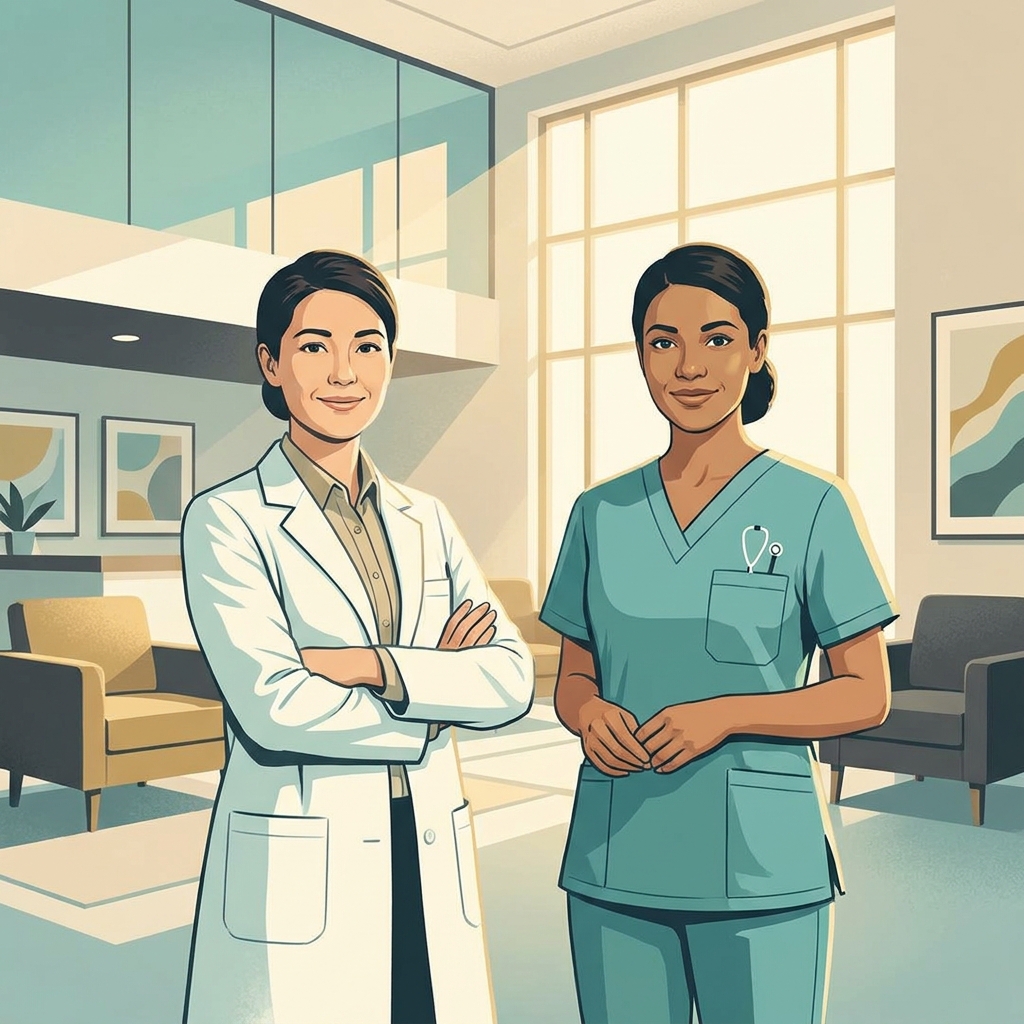
Nurse Practitioner Physician Assistant Healthcare Roles: The 2026 Patient and Professional Guide to America’s Fastest-Growing Care Team
Introduction: The New Face of Your Healthcare Team
A patient walks into a clinic for a routine checkup. The provider who greets them wears a badge reading “NP” or “PA.” For millions of Americans, this scenario has become the norm rather than the exception. Understanding who these healthcare professionals are and what they do has never been more important.
The numbers tell a compelling story. Approximately 450,000 nurse practitioners and over 189,000 board-certified physician associates now practice across the United States, collectively serving tens of millions of patients every week. These advanced practice providers have become essential pillars of the American healthcare system.
This guide serves two distinct audiences. For patients, it answers the fundamental question: “Who am I seeing and why?” For healthcare professionals, it explores how these roles integrate into modern medical practice and what the future holds for team-based care.
The regulatory landscape of 2026 marks a pivotal moment. Full practice authority for nurse practitioners now extends to 34 states plus Washington D.C. The PA Compact spans more than 23 states. The transition from “physician assistant” to “physician associate” continues to reshape professional identity across the nation.
One principle remains central to this discussion: NPs and PAs are not physician replacements. They are collaborative partners in a physician-led team model that represents the evolving standard of American healthcare delivery.
Understanding Advanced Practice Providers: Who Are NPs and PAs?
The term “Advanced Practice Provider” (APP) serves as an umbrella designation encompassing both nurse practitioners and physician associates. While grouped together for administrative and policy purposes, these two professions maintain distinct educational foundations, philosophical approaches, and regulatory histories.
Both professions consistently rank among the top five fastest-growing careers in the United States. The Bureau of Labor Statistics identified the NP role as the number one fastest-growing healthcare career in 2025. This growth trajectory reflects deliberate healthcare policy decisions rather than coincidence.
The origins of both professions trace back to the 1960s, when physician shortages prompted the creation of new clinical roles. That original mission resonates powerfully today. The Association of American Medical Colleges projects a shortage of up to 86,000 physicians by 2036, making APPs more essential than ever.
The access crisis already affects millions. More than 83 million Americans currently live in primary care shortage areas, positioning APPs as frontline solutions to a present challenge rather than a future concern.
Nurse Practitioners: A Closer Look
A nurse practitioner is a registered nurse who has completed advanced graduate-level education, either a Master of Science in Nursing (MSN) or Doctor of Nursing Practice (DNP), and holds national board certification in a specific patient population.
The NP profession operates from a nursing-based, patient-centered care model that emphasizes holistic approaches to health. This philosophical foundation distinguishes NP practice from the traditional medical model, prioritizing patient education, prevention, and whole-person wellness.
NPs specialize by patient population rather than disease category. Common specializations include Family Nurse Practitioner (FNP), Pediatric Nurse Practitioner (PNP), Adult-Gerontology Primary Care Nurse Practitioner (AGPCNP), Psychiatric-Mental Health Nurse Practitioner (PMHNP), and Women’s Health Nurse Practitioner (WHNP).
More than 90 percent of NPs work in primary care settings, making them the backbone of accessible everyday healthcare. The Bureau of Labor Statistics reports NPs earn a median annual salary of $129,210, more than double the average annual wage for all U.S. occupations.
Employment projections underscore the profession’s growth trajectory. The BLS projects 46 percent growth from 2023 to 2033, adding over 135,000 new NP positions. This rate exceeds ten times the average growth for all occupations.
NPs hold prescriptive privileges in all 50 states and can administer controlled substances in 49 states, enabling comprehensive patient care across most clinical scenarios.
NP Education and Training: From Bedside Nurse to Advanced Clinician
The pathway to becoming an NP requires an active registered nurse license followed by two to four years of graduate education at the MSN or DNP level. This foundation in nursing practice provides clinical experience before advanced training begins.
NP programs mandate 500 to 1,000 supervised clinical hours within the student’s chosen specialty population. This targeted clinical training develops deep expertise in a defined patient group rather than broad exposure across all medical specialties.
The American Association of Colleges of Nursing reaffirmed in its 2025 Position Statement that the DNP represents the preferred terminal degree for advanced practice nurses. This professional doctorate focuses on clinical practice rather than research, distinguishing it from the PhD pathway.
Physician Associates (PAs): A Closer Look
A physician associate is a nationally certified and state-licensed medical professional who practices medicine as part of a physician-led team. The profession follows a medical model framework, with training that mirrors physician education in structure and covers all major organ systems and medical specialties.
The generalist training approach provides PAs with unique flexibility. Unlike NPs, who specialize in specific populations, PAs can transition between specialties throughout their careers without obtaining additional formal credentials. A PA trained in emergency medicine can move into orthopedics or cardiology based on practice needs and personal interests.
Distribution patterns differ markedly from NPs. Only about 22 percent of PAs work in primary care settings, with the majority practicing in surgical and specialty environments. This concentration complements the NP primary care focus, creating a balanced APP workforce across healthcare settings.
The NCCPA reports over 189,907 board-certified PAs as of December 31, 2024, providing care to an estimated 11.4 million patients weekly. Median PA salary reaches approximately $133,000, with the BLS projecting 28 percent employment growth from 2023 to 2033.
The professional title itself has undergone significant evolution. The American Academy of Physician Associates voted in 2021 to officially change “physician assistant” to “physician associate,” better reflecting the profession’s collaborative rather than subordinate role within healthcare teams.
PA Education and Training: A Generalist Medical Foundation
PA programs accept candidates from any undergraduate background, requiring a bachelor’s degree plus healthcare experience before admission. The subsequent two to three years of intensive medical training occurs at the master’s level.
Clinical training encompasses approximately 2,000 hours of supervised rotations across multiple specialties, including surgery, internal medicine, pediatrics, and emergency medicine. This breadth of exposure prepares PAs to adapt across clinical settings throughout their careers.
Unlike the NP profession’s movement toward the DNP, PA programs remain at the master’s level with no current parallel push toward a clinical doctorate. The generalist educational design remains intentional, producing medical professionals capable of meeting diverse healthcare needs.
NP vs. PA: Key Differences Patients and Professionals Should Know
Understanding the distinctions between these professions helps patients navigate their care and helps professionals build effective teams.
Educational Background: NPs build upon nursing degrees with graduate education in a specialty population. PAs enter from any undergraduate field and receive generalist medical training.
Care Philosophy: NPs bring a nursing lens emphasizing patient education, prevention, and whole-person wellness. PAs bring a medical lens mirroring physician clinical reasoning.
Specialty Focus: NPs develop deep expertise in defined patient populations. PAs maintain flexibility to practice across specialties.
Practice Distribution: More than 90 percent of NPs work in primary care. Only 22 percent of PAs practice in primary care settings.
Supervision Requirements: NPs in full practice authority states operate independently. PAs typically practice under physician supervision, though requirements vary significantly by state.
Neither model proves inherently superior. The appropriate APP for a patient depends on clinical setting, patient needs, and care team structure.
A common misconception suggests that seeing an NP or PA means receiving lesser care. Research contradicts this assumption. A 2024 systematic review of 117 systematic reviews found consistent evidence that NP care equals or exceeds physician care across multiple settings. Patient satisfaction data supports this finding: 89 percent of patients express comfort with NPs as primary care providers, rising to 94 percent among those who have previously received NP care.
The 2026 Regulatory Landscape: What’s Changing and Why It Matters
The regulatory environment for APPs is shifting faster in 2026 than at any point in the past decade. These changes directly affect who can provide care, where, how independently, and at what cost.
Full Practice Authority for NPs: The 34-State Milestone
Full practice authority enables NPs to evaluate, diagnose, order tests, and prescribe medications entirely independently without physician oversight. As of 2026, 34 states plus Washington D.C. grant this authority, up dramatically from only 22 states and D.C. in 2020.
The 2025 legislative session brought remarkable momentum. Michigan, Alabama, Louisiana, South Carolina, and Wisconsin all joined the full practice authority group within a single year.
Access data demonstrates tangible benefits. Rural counties in full practice authority states are 62 percent more likely to have at least one NP providing primary care services compared to similar counties in restricted states. Full practice authority adoption correlates with an average 11 percent reduction in primary care costs and an eight-day decrease in patient wait times.
California’s approach illustrates the complexity of this transition. AB 890 created two certification tiers: the 103 NP (supervised) and 104 NP (fully independent). Full independent practice applications under the 104 NP pathway are expected to open in 2026 following three years of supervised experience.
The PA Title Change: From “Physician Assistant” to “Physician Associate”
The transition from “physician assistant” to “physician associate” continues gaining legislative traction. Oregon, Maine, and New Hampshire have enacted statutory title changes, with legislation pending in Ohio, New Jersey, Wisconsin, and other states.
For patients, the title change carries no impact on care delivery. The new designation describes the PA’s collaborative role more accurately. Survey data indicates 71 percent of patients agree that “physician associate” better matches the actual PA job description.
California’s AB 1501, effective January 1, 2026, increased the permissible physician-to-PA supervision ratio from 1:4 to 1:8, expanding PA practice capacity across the state.
The PA Compact: Interstate Practice in 23+ States
The PA Compact functions as an interstate licensure agreement allowing PAs to practice across state lines more efficiently. As of 2026, more than 23 states have enacted the compact, with legislation pending in eight additional states.
For patients, the Compact improves access to PA care in rural and underserved areas, enhances continuity for those who travel or relocate, and expands telehealth coverage. For PA professionals, it provides career mobility, easier locum tenens practice, and stronger telehealth delivery platforms.
How NPs and PAs Work Within Physician-Led Care Teams
The most effective healthcare delivery model positions NPs and PAs as collaborative partners within physician-led teams rather than competitors or replacements.
Typical team structures assign physicians to oversee patient panels while NPs manage chronic disease follow-ups, PAs handle surgical pre- and post-operative care, and all three consult on complex cases. This distribution allows physicians to focus on the most challenging clinical scenarios while APPs ensure comprehensive coverage.
For patients wondering whom they should see: routine primary care, preventive visits, and chronic disease management fall well within NP and PA qualifications. Complex diagnoses, surgical decisions, and rare conditions typically involve physician engagement.
The AAMC projects NP supply will increase 66 percent and PA supply 37 percent between 2024 and 2034. This growth represents an intentional healthcare system response to the physician shortage, not a challenge to physician authority.
For Patients: Navigating Your Care Team With Confidence
Seeing an NP or PA represents a feature of well-designed healthcare systems, not a limitation of access.
Patients meeting an NP or PA for the first time might ask: What is your specialty? How do you coordinate with the physician on my care team? What conditions fall within your scope of practice?
Understanding practice models helps set expectations. Some NPs operate independent practices in full practice authority states. Others work within physician-supervised teams. Both models deliver quality care through different structures.
Regarding the title transition: if a provider’s badge reads “physician associate” rather than “physician assistant,” the care provided remains identical. The title evolution reflects professional development, not clinical changes.
Patients can verify credentials directly. NPs should hold board certification from AANP or ANCC. PAs should maintain NCCPA board certification. Both professions carry malpractice insurance, and expanded autonomy has brought increased attention to liability standards.
The Physician Shortage: Why NPs and PAs Are America’s Healthcare Safety Net
The physician shortage represents a present crisis, not merely a future concern. The AAMC projects shortfalls of 17,800 to 48,000 primary care physicians by 2036. More than 83 million Americans already live in primary care shortage areas.
NPs and PAs constitute the structural solution the healthcare system is actively deploying. Full practice authority, the PA Compact, and permanent telehealth flexibilities serve as policy mechanisms designed to maximize APP impact where physician access falls short.
The physician shortage makes physician-APP collaboration essential rather than optional. The productive question is not whether APPs should expand their roles but how teams can work most effectively together.
Conclusion: A Stronger Healthcare System, Built Together
For patients, NPs and PAs represent highly qualified, evidence-supported providers who serve as intentional and valuable members of care teams. For professionals, the APP-physician collaborative model defines the future of American healthcare delivery.
The 2026 regulatory landscape marks a new era. With 34 states granting NP full practice authority, the PA Compact spanning more than 23 states, and the physician associate title gaining recognition, both professions have entered a period of expanded responsibility and professional acknowledgment.
The most effective care teams leverage the unique strengths of each member: the holistic nursing expertise of NPs, the generalist medical training of PAs, and the diagnostic authority of physicians. All serve the patient.
Top Doctor Magazine profiles physicians, NPs, and PAs alike, reflecting the collaborative reality of modern healthcare. As the physician shortage deepens, the expansion of NP and PA roles represents not a compromise but a carefully evidenced evolution of how America delivers care.
The healthcare team of 2026 stands more capable, more accessible, and more collaborative than ever before.
Explore More With Top Doctor Magazine
Top Doctor Magazine invites patients to explore provider profiles featuring NPs, PAs, and physicians who exemplify excellence in team-based care. Healthcare professionals, including NPs and PAs, can discover opportunities through the Top Doctor Magazine awards program and editorial features to build professional visibility and share their stories with broader audiences.
The free biweekly Top Doctor Magazine newsletter delivers healthcare workforce trends, regulatory updates, and provider spotlights relevant to both patients and professionals. Readers who have experienced exceptional care from an NP, PA, or physician can nominate that provider for a Top Doctor Magazine feature or award. The Top Doctor Magazine podcast offers deeper conversations with healthcare professionals about team-based care, emerging medicine, and the evolving APP landscape.